Foundation and Slab Cracks in Davie: When to Worry and Who to Call
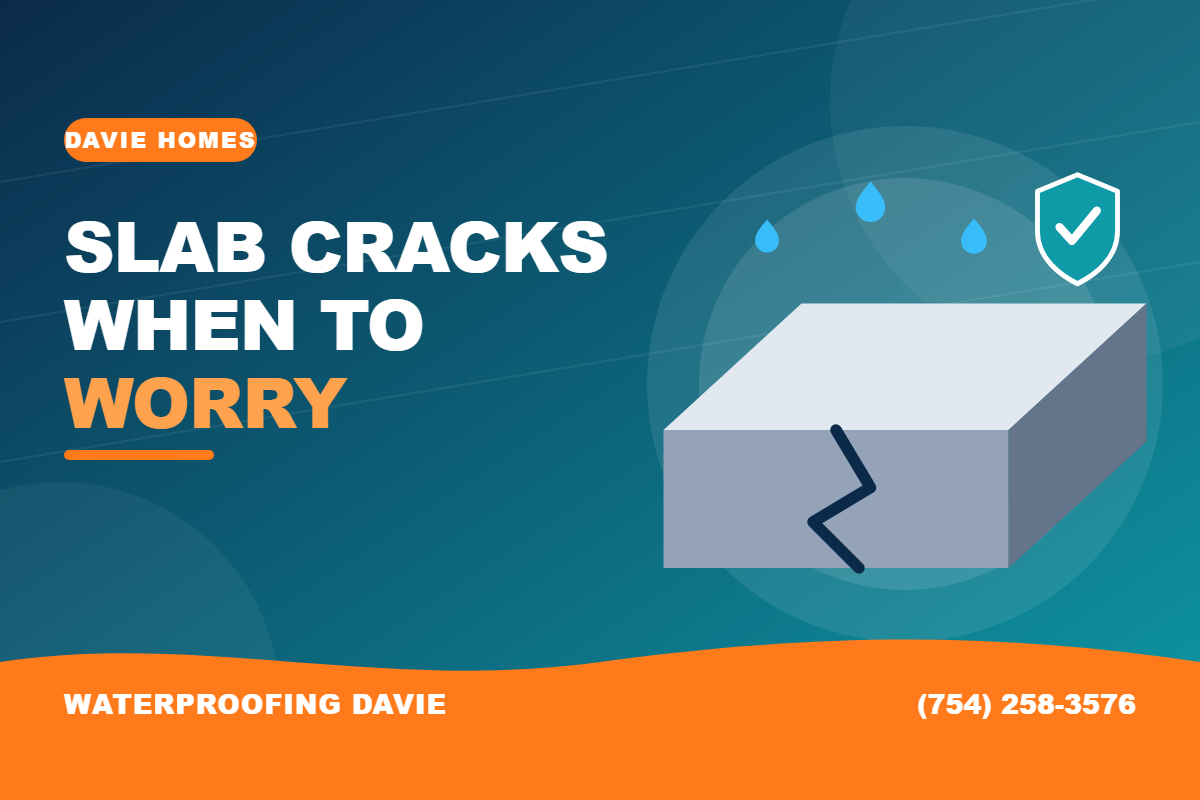
Finding a crack in a garage floor, patio slab or foundation wall is unsettling. In reality, concrete cracks are extremely common, and most are shrinkage cracks that formed as the concrete cured and dried. A few, though, indicate movement, poor drainage or soil problems and deserve attention. Here is when to worry about foundation cracks, and when to relax.
This guide helps Davie homeowners tell the difference. It covers the types of cracks, how to monitor them, what causes them in South Florida’s sandy, high-water-table soils, what waterproofing and sealing can do and what must be left to a structural professional.
Quick Answer
Hairline vertical or random cracks are usually shrinkage and often cosmetic. Wide, widening, stair-step, horizontal or offset cracks, especially with doors that stick or walls that bow, may signal structural movement and need an engineer’s evaluation. Sealing a crack helps keep water out but does not fix structural causes.
In This Guide
- Why Concrete Cracks
- When to Worry About Foundation Cracks: Crack Types
- How to Monitor a Crack
- South Florida Conditions That Affect Slabs
- What Sealing and Waterproofing Can Do
- How Cracks Are Sealed
- When to Call a Structural Professional
- Cracks and Moisture
- Garage and Patio Slab Joints
- Trees, Roots and Plumbing
- Documenting Cracks for a Professional
- Frequently Asked Questions
Why Concrete Cracks
- Shrinkage: concrete loses water as it cures and shrinks.
- Temperature changes: expansion and contraction.
- Soil settlement or erosion: uneven support under the slab.
- Water: saturated soil, poor drainage and root growth.
- Overloading: heavy loads on slabs not designed for them.
- Reinforcement corrosion: rusting steel expands and cracks the concrete.
- Missing control joints: concrete cracks where it is weakest.
Seeing cracks you are unsure about? Our foundation repair in Davie, FL page explains how we connect you with an independent contractor who can assess them.
When to Worry About Foundation Cracks: Crack Types
| Crack | What it looks like | Usually means | Next step |
|---|---|---|---|
| Hairline | Very thin, random or straight | Shrinkage | Seal if water can enter; monitor |
| Control-joint cracks | Straight line where a joint was cut | Intended behavior | Seal joint with flexible sealant |
| Vertical wall crack | Narrow, vertical | Shrinkage or minor settlement | Seal and monitor |
| Horizontal wall crack | Runs along the wall | Pressure from soil or water | Professional evaluation |
| Stair-step crack | Follows block joints | Differential settlement | Professional evaluation |
| Offset or uneven crack | One side higher than the other | Slab movement | Professional evaluation |
| Widening crack | Grows over time | Ongoing movement | Professional evaluation |
How to Monitor a Crack
- Mark both ends of the crack with a pencil and date it.
- Photograph the crack with a ruler beside it.
- Measure the width at the widest point.
- Re-check monthly and after heavy rain.
- If it grows, spreads or gets uneven, call a professional.
South Florida Conditions That Affect Slabs
Much of South Florida has sandy soil and a shallow water table. Saturated soil can erode under slabs and edges, roots can lift pavements and drainage problems can undermine support. Good grading and drainage help; see French drains and yard drainage in Davie.
What Sealing and Waterproofing Can Do
- Block water from entering cracks and reaching reinforcement.
- Reduce staining and efflorescence.
- Protect against moisture moving through the slab.
- Extend the life of the surface.
They cannot fix settlement or structural cracks. Learn more about concrete sealing in South Florida and the moisture control page.
How Cracks Are Sealed
- Clean out dirt, oil and loose concrete.
- Remove dust.
- Use a flexible sealant, epoxy or polyurethane injection depending on crack type and purpose.
- Tool the sealant flush.
- Apply a sealer or coating over the area if desired.
Structural cracks may need epoxy injection or other engineered repairs, which should be specified by an engineer.
When to Call a Structural Professional
- Cracks wider than a pencil width or growing.
- Stair-step or horizontal cracks in walls.
- Slab sections that have dropped or tilted.
- Doors and windows that bind or do not close.
- Gaps between walls and floors.
- Water entering through the crack.
We are not engineers and waterproofing contractors cannot diagnose structural conditions. A licensed structural engineer or qualified foundation professional can evaluate structural cracks.
Cracks and Moisture
Water entering through a crack is a waterproofing problem; the crack itself might be a structural one. Both may need attention. See also stucco cracks in Florida for wall cracks.
Garage and Patio Slab Joints
Garages and patios often have saw-cut joints designed to control cracking. Keep them clean and filled with flexible sealant so that water and debris do not enter and erode the support below. Failed joint sealant often shows up as dark lines and weeds in the joint.
Trees, Roots and Plumbing
Roots can lift slabs, and leaking underground pipes can saturate and wash away soil. If a slab has moved near a large tree or plumbing line, ask a professional to check both.
Documenting Cracks for a Professional
- Photograph with a ruler or coin for scale.
- Record date and weather.
- Note any doors, windows or walls that changed behavior.
- Mark crack ends and measure over time.
- Share the log when you request an evaluation.
If you want a contractor to look at slab or wall moisture, contact the Waterproofing Davie referral service at (754) 258-3576. Independent contractors can inspect and advise on sealing; they will tell you when an engineer is needed.
Frequently Asked Questions
Get a Written Estimate From a Local Contractor
Call or text (754) 258-3576 with your address and a photo of the problem. We connect you with an independent contractor who inspects the property and gives you a written estimate before any work starts.
Waterproofing Davie is a local referral service. Independent contractors perform the work and provide their own estimates, licenses, insurance and warranties, so ask each one for those details in writing. This article is general information and does not replace an on-site inspection.