
Home › Services › Rooftop Deck & Planter Waterproofing
Rooftop Deck and Planter Waterproofing in Davie, FL
Rooftop terraces, pool decks and planters sit on top of occupied space. The waterproofing underneath them has to handle foot traffic, wet soil, furniture and tropical rain without leaking into the rooms below. Rooftop deck waterproofing in Davie, FL protects the space below.
Local referral to independent contractors · Written estimate before work starts · Emergency leaks welcome
Rooftop Decks at a Glance
~60 in.
of rain a year falls on Davie rooftops
Membrane
is the actual waterproofing layer
Drains
are the most critical detail on any deck or planter
Protection
keeps furniture and soil from damaging the membrane
Quick Answer: What Is Rooftop Deck Waterproofing in Davie, FL?
Rooftop deck and planter waterproofing protects occupied space beneath terraces, roof gardens, pool decks and planters. A continuous waterproof membrane is installed or repaired, drains and flashings are sealed to it, and protection and drainage layers shield it from pavers, soil and traffic. It prevents leaks into units, garages and corridors below and protects structural concrete and steel. Call (754) 258-3576 or text photos for a written estimate from an independent local contractor.
Rooftop decks are one of the most demanding waterproofing jobs. See the full range of Davie waterproofing services we help with.
Signs a Rooftop Deck or Planter Is Leaking
Watch both the deck and the space below it.
Stains and drips below
Water marks, peeling paint or dripping in rooms, garages or corridors beneath the deck point to membrane failure.
Ponding and slow drains
Puddles that remain after rain suggest clogged drains or low spots that stress the membrane.
Cracked pavers and lifted tiles
Movement in the finish layer can mean water is moving underneath.
Wet soil and plant problems
Soggy planters, root growth at edges and damp walls show drainage or membrane trouble.
How Water Gets Through a Rooftop Deck
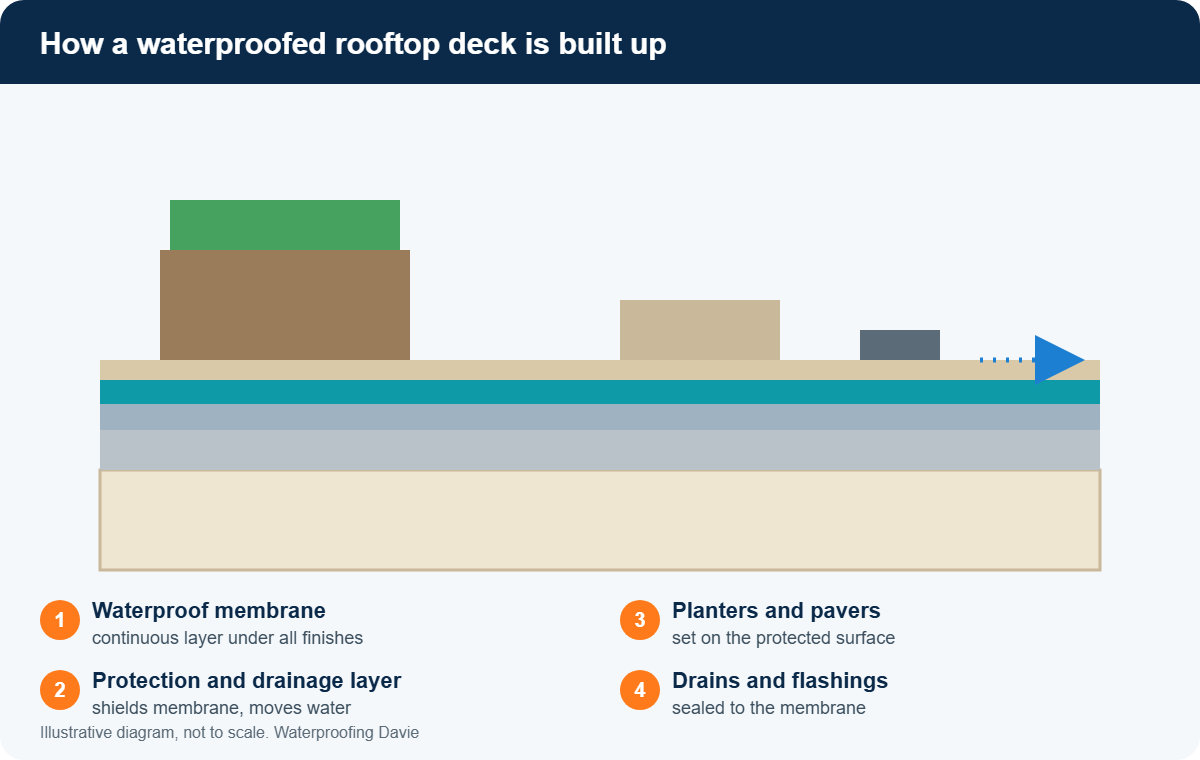
A rooftop deck is a layered system. Water sits on top of the membrane for hours and, in planters, for days. If the membrane has pinholes, failed seams or poor details at drains and walls, water finds a way into the structure.
Drains are a frequent weak point. A clogged drain causes ponding, which then pushes water through every small defect. Wet soil in planters also releases roots, fertilizers and acids that can attack membranes not rated for them.
Waterproofing is the membrane and its details. The layers above protect it. When any layer is skipped or damaged, leaks are likely and often hard to trace.
Rooftop Deck Waterproofing Systems Compared
Systems vary by structure, finish and budget.
| System | What it is | Best for | Watch out for |
|---|---|---|---|
| Liquid-applied membrane | Seamless coating, often polyurethane or polymer-modified | Complex shapes with many details | Needs even thickness and careful cure |
| Hot-applied rubberized asphalt | Heavy, seamless membrane with a protection course | Plaza decks and heavy loads | Requires specialist crews and safety controls |
| Sheet membranes (PVC, TPO, EPDM) | Factory sheets joined at seams | Large, simple roof areas | Seam quality and details are critical |
| Bituminous built-up or modified bitumen | Multiple layers with a cap sheet | Conventional low-slope decks | Needs sound substrate and proper flashing |
| Cementitious waterproofing | Cement-based coating on concrete | Planter interiors and small areas | Can crack if the slab flexes |
| Inverted roof assembly | Insulation above the membrane with ballast or pavers | Energy-efficient green roofs | Requires careful drainage and loading checks |
Ask which system suits the structure, how it will be protected and what warranty is available for that system.
Waterproofing by Rooftop Element
Each element has its own risks.
Terraces carry traffic and furniture.
- Inspect and repair the membrane and details
- Install protection and drainage layers
- Reinstall pavers or decking on pedestals
Check slope and drains before reinstalling finishes.
Planters hold soil and water for long periods.
- Line planter floors and walls with a suitable membrane
- Add root protection, drainage and filter fabric
- Provide overflow drains
Plant roots should never reach the membrane.
Drains move water off the roof.
- Clean, test and seal drain flanges to the membrane
- Add strainers and overflow provisions
- Check slopes toward each drain
Never leave a clogged or poorly sealed drain.
Every vertical element needs flashing.
- Turn the membrane up walls and curbs
- Install termination bars and sealant
- Seal pipes, posts and equipment supports
Penetrations are the most common leak points.
Pools on rooftops add serious loads and moisture.
- Coordinate structure, membrane and pool shell waterproofing
- Use protected drainage layers under finishes
- Involve engineers and pool specialists
Pool-over-occupied-space jobs need professional design.
How Rooftop Deck Waterproofing Works: Four Steps
A reliable job follows this order.
1
Investigate and document
Inspect drains, seams, flashings and finishes, review drawings and find where water is entering.
2
Open and prepare
Lift finishes in the work area, clean and repair the substrate and correct slopes.
3
Install membrane and details
Apply the membrane, flash walls and penetrations and test or inspect the result.
4
Protect and rebuild
Install protection and drainage layers, reinstall finishes and planters and document the work.
Rooftop Leak Causes and Typical Responses
| What you see | What it usually means | Typical response |
|---|---|---|
| Leak after heavy rain | Drain or flashing problem | Inspect and re-seal drain and flashing details |
| Constant drip below planter | Failed planter membrane or drain | Open the planter and repair or replace the lining |
| Efflorescence on the ceiling below | Water moving through concrete | Find entry point and repair membrane |
| Blistered or lifted membrane | Trapped moisture or poor bond | Remove, dry and repair affected area |
| Cracked pavers | Settling or movement | Re-level and check the membrane beneath |
| Ponding water | Poor slope or clogged drain | Correct slope and clean drains |
Repair, Overlay or Replace the Membrane?
| Condition | Typical approach | Why |
|---|---|---|
| Isolated leaks at details | Targeted repair | Lowest cost and disruption |
| Aging but dry system | Maintenance and re-flashing | Extends life and delays replacement |
| Widespread failure | Remove finishes and replace the membrane | Patching will not hold |
| Wet insulation or deck damage | Replace affected layers and membrane | Trapped moisture causes ongoing problems |
| Planned redesign | Replace membrane as part of the project | Best time to improve drainage and protection |
Ask whether a leak survey or flood test is recommended before choosing the repair.
What Affects the Cost of Rooftop Deck Waterproofing
We do not quote prices by phone because every rooftop differs.
| Factor | Why it matters | Effect on cost |
|---|---|---|
| Area and complexity | More details and edges increase labor | Higher |
| Finishes on top | Pavers, decking and planters must be lifted and reinstalled | Higher |
| System selected | Membranes and protection layers differ in cost | Varies |
| Access and logistics | Cranes, hoists and limited access add costs | Higher |
| Condition below | Wet insulation or damaged structure adds scope | Higher |
| Permits and approvals | Engineering and association review add steps | Varies |
Mistakes That Cause Rooftop Deck Leaks
- Covering a wet or damaged substrate. Trapped moisture causes blisters and failure.
- Skipping protection layers. Pavers, soil and furniture puncture exposed membranes.
- Neglecting drains. Poor slope and blocked drains drive water through every weak spot.
- Weak details at walls and penetrations. Most leaks begin there, not in the middle.
- Using planter materials not rated for roots and wet soil. Roots and acids attack them.
- Not testing before covering. A flood or leak test is cheaper than lifting finishes twice.
- Choosing only on price. Missing layers and thin coverage fail quickly.
Why Rooftop Waterproofing Is Demanding in Davie
South Florida’s weather tests every layer of a rooftop deck.
Intense rain
Summer storms deliver large volumes of water in short periods, so drains and overflows must work. If drains clog, the deck can pond quickly.
Strong sun and heat
Heat cycles stress membranes, sealants and finishes, and dark surfaces get very hot.
Wind and storms
Hurricane season puts pressure on edges, curbs and loose items. Secure furniture and planters and check flashing details. See our guidance on roof waterproofing for the roof system below.
Occupied space below
Condos, offices and garages beneath decks mean a leak is expensive and disruptive. Related low-slope roof coatings are covered on our flat roof coating page.
A Rooftop Deck Care Calendar for Davie
| When | What to do | Why it helps |
|---|---|---|
| Late winter to spring (Feb – Apr) | Inspect drains, flashings, finishes and planters, and schedule repairs. | Work is done before the rainy season. |
| Rainy season (May – Oct) | Clear drains after each storm and watch for ponding and stains below. | Early notice keeps repairs small. |
| Before a named storm (Jun 1 – Nov 30) | Secure furniture and planters, clear drains and photograph conditions. | Reduces debris and documents conditions. |
| After a major storm | Check drains, edges and the space below for leaks. | Fast response limits damage. |
| Drier months (Nov – Jan) | Schedule membrane and detail work. | Dry weather helps cure and testing. |
Rooftop Waterproofing for Different Property Types
| Property type | Common situation | What owners usually need |
|---|---|---|
| Condominiums | Amenity decks and rooftop pools | Association approval, phased work and documentation |
| Apartment buildings | Terraces and courtyards above garages | Durable membranes and drainage upgrades |
| Office and commercial buildings | Roof terraces and equipment platforms | Scheduling around tenants and building systems |
| Hospitality and restaurants | Rooftop dining and event spaces | Quick turnaround and guest-safe finishes |
| Single-family homes | Roof terraces over living space | Membrane and detail repair with a clear scope |
What a Good Rooftop Deck Estimate Should Include
- Investigation findings: photos, moisture readings and leak locations.
- Scope of removal and reinstall: which finishes and planters will be lifted.
- The exact system: membrane type, thickness and protection layers.
- Drainage plan: drains, slopes and overflows.
- Details: walls, curbs, penetrations and edges.
- Testing: flood or leak tests before finishes go back.
- Protection and logistics: access, hoisting and how occupants are protected.
- Approvals: engineering, permits and association requirements.
- Warranty: what is covered, for how long and what voids it.
Caring for a Rooftop Deck
- Keep drains, scuppers and overflows clear of leaves and debris.
- Use pedestals, pads and planters designed for roof decks.
- Avoid dragging heavy items and sharp objects across finishes.
- Check planters for overwatering and root growth near edges.
- Inspect flashings and sealants each spring and after storms.
- Keep drawings, product data and warranties in one file.
Questions to Ask Before You Approve Rooftop Deck Work
| Question | Why it matters | What a good answer sounds like |
|---|---|---|
| How will you find the real source of the leak? | Patching the wrong spot wastes money | An investigation method is described |
| What membrane system and thickness? | System choice drives life and warranty | Product, thickness and layers are in writing |
| How will you protect the membrane afterward? | Traffic and soil can damage it | Protection and drainage layers are specified |
| How are drains and planters handled? | Drains are the most critical detail | Drain flashing and overflow details are explained |
| Will there be a leak test? | Testing prevents repeat work | Flood or electronic testing is planned |
| What does the warranty cover? | Terms vary widely | Written terms with exclusions listed |
Planters, Green Roofs and Wet Soil
Planters and green roofs add beauty and shade, but they hold weight and water. A planter on a roof is essentially a small tank, so it needs its own waterproofing and drainage.
Membrane and root protection
Planter interiors should be lined with a membrane rated for wet soil and, in many cases, root barriers so that roots do not penetrate seams.
Drainage and overflow
Soil should drain freely into a drain or scupper, with an overflow if the main drain clogs. Standing water in a planter keeps pressure on the membrane for days.
Weight and structure
Wet soil is heavy. Before adding or moving planters, have a structural professional confirm that the roof can carry the load.
Irrigation
Over-irrigation floods planters and can overwhelm drains. Match watering to plant needs and keep irrigation lines away from edges and flashings.
Leak Detection on Rooftop Decks
Finding the source of a rooftop leak is often harder than fixing it. Water can travel along the slab, insulation or membrane before it shows up below, so the stain on a ceiling is rarely directly under the entry point.
Visual and moisture surveys
Inspectors look at drains, seams, flashings and finishes, and may use moisture meters or infrared cameras to find wet insulation and damp substrates.
Flood testing
Plugging drains and flooding a section of deck for a set time can show whether the membrane holds. It is commonly used before finishes are reinstalled.
Electronic leak detection
Specialized equipment can pinpoint pinholes in some membranes. Ask a contractor whether this is appropriate for your system.
Why this matters
A targeted repair at the real source costs less than replacing the whole system on a guess. For a broader look at moisture across a building, see our page on waterproofing inspection and moisture surveys.
Rooftop Deck Project Timeline
Every project differs, but most follow this general pattern.
| Stage | What happens | General notes |
|---|---|---|
| Investigation | Inspect, review drawings and test for leaks | Defines the real scope |
| Approvals and planning | Associations, engineers and managers review the plan | May take longer than the work |
| Removal and preparation | Lift finishes and prepare the substrate | Weather protection is essential |
| Membrane installation | Apply and inspect the membrane and details | Testing happens here |
| Protection and reinstall | Install protection layers and rebuild finishes and planters | Document the work with photos |
| Final review | Walk the deck, review care and warranty documents | Keep paperwork for future service |
Safety, Loads and Code Considerations
Rooftop decks combine weight, people and water, so safety matters as much as waterproofing.
Structural loads
Pavers, pedestals, wet soil, furniture and crowds add weight to a roof. Always have a structural professional confirm the load capacity before adding planters, pools or heavy finishes.
Guards, edges and parapets
Railings and parapets must meet local code for height and strength. Posts that penetrate the membrane need sealed flashing details, and railing work belongs to qualified trades.
Drainage and overflow
Building codes commonly require secondary or overflow drainage on roofs. Confirm that new finishes do not block it.
Fire and wind
Materials used on roofs may need specific fire and wind ratings in hurricane-prone areas. Ask your contractor which ratings apply to the system chosen.
Permits and inspections
Changes to structure, drainage or use usually need permits. Your contractor and association can confirm what is required for your property.
Who Does the Work
Waterproofing Davie is a local referral service. We do not perform the work ourselves. Independent contractors do the work and provide their own written estimate, warranty terms, license and insurance details. Before you approve work, ask the contractor to confirm their Florida license and insurance in writing and verify both with the State of Florida. Rooftop decks often involve architects, engineers, landscape contractors and building managers, so scope, permits and warranties should be agreed in writing.
Frequently Asked Questions About Rooftop Deck and Planter Waterproofing in Davie
Related Waterproofing Services
Get a Rooftop Deck Waterproofing Estimate in Davie
Tell us about the deck, planters or terrace, what is under it and any leaks or stains you see. Photos and drawings help. You will get a plain-language explanation and a written estimate before any work starts.