
Home › Services › Exterior Wall Waterproofing
Exterior Wall Waterproofing in Davie, FL
Davie walls take months of rain, strong sun and storm winds. Exterior wall waterproofing seals block, stucco and concrete so water stays out, paint lasts longer and the inside of the building stays dry.
Local referral to independent contractors · Written estimate before work starts · Emergency leaks welcome

Exterior Walls at a Glance
~60 in.
of rain a Davie wall faces in a typical year
Block + stucco
the most common wall system in South Florida
Jun 1 – Nov 30
storm season, when wind-driven rain tests every wall
Breathable
a good coating sheds liquid water yet lets vapor out
Quick Answer: What Is Exterior Wall Waterproofing?
Exterior wall waterproofing is a system that stops rain from soaking into the outside walls of a building. It usually combines repairs to cracks and joints with a flexible coating, a masonry waterproofing paint or a clear penetrating repellent, chosen to suit the wall. Done correctly, it reduces stains, peeling paint, damp interiors and the growth that follows. Call (754) 258-3576 or text photos for a written estimate from an independent local contractor.
Walls are one part of the building’s defense against water. For roofs, windows, slabs and drainage as well, see our complete waterproofing solutions for Davie buildings.
Signs Your Exterior Walls Need Waterproofing
Check walls on a dry day, and again after heavy rain.
Damp or darkened walls
Wall areas that stay dark after rain, or feel cool and damp, are absorbing water instead of shedding it.
Peeling, chalking or blistering paint
Paint that bubbles, flakes or leaves white powder on your hand has lost its bond or is being pushed off by moisture.
Algae, mold-like growth and white powder
Green or black growth, especially on shaded walls, and white mineral deposits show moisture is moving through the wall.
Damp interiors and musty smell
Stains, bubbling paint or a musty odor on interior walls can mean water is passing through the exterior wall.
Why Walls Absorb Water
Block, stucco and concrete look solid, but they are porous. Millions of tiny pores soak up water like a sponge, especially when the paint has worn thin or the surface has fine cracks. In Davie, rain is frequent and heavy, and wind pushes it hard against the wall, so water has constant opportunity to enter.
Once water is in, it travels. It can wet the block, carry salts to the surface as white powder, and feed algae outside and mold on interior finishes. Repeated wetting and drying also weakens paint and can corrode metal lath and reinforcing steel.
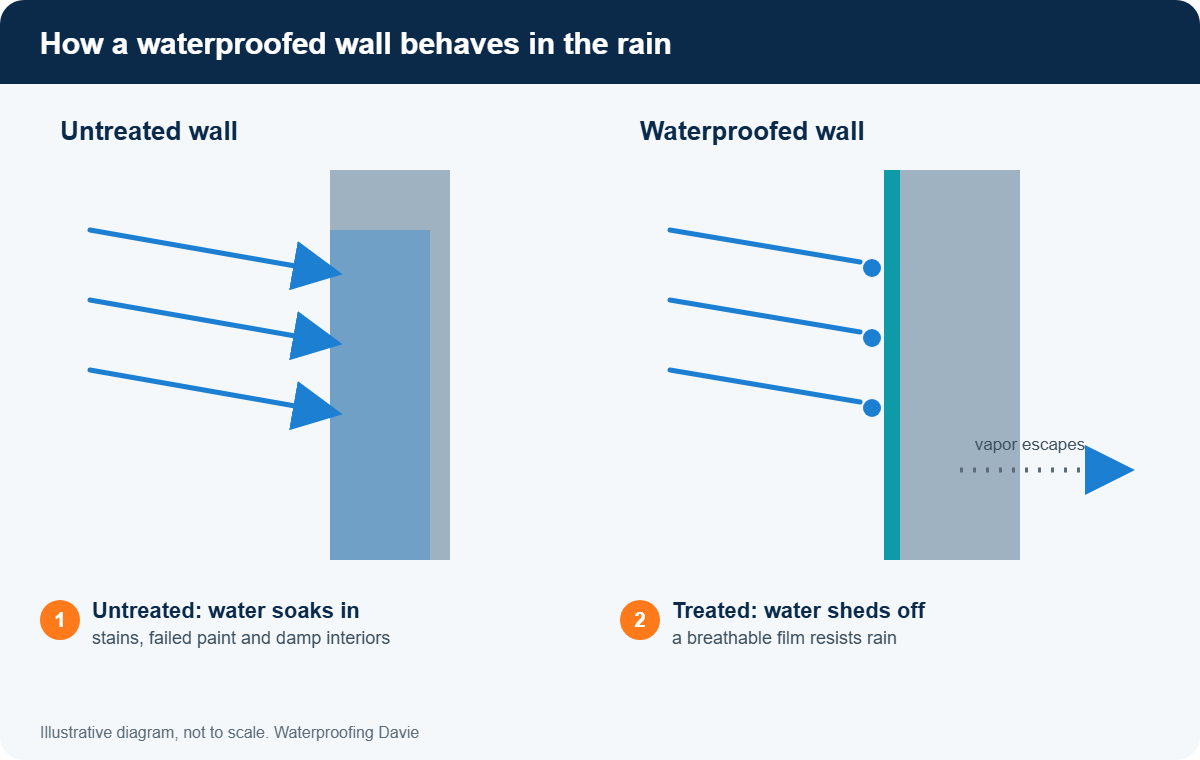
A waterproofing system works by closing the pores and joints and giving the surface a flexible, breathable film. Water runs off, while vapor can still escape from inside. This is different from a thick plastic-like coating that traps moisture, which causes its own problems.
Wall Waterproofing by Wall Type
The right system depends on what the wall is made of. Choose the one closest to yours.
Concrete block with stucco is the most common wall system in Davie.
- Repair cracks and loose stucco first
- Clean the surface and apply primer where the product requires it
- Apply a flexible elastomeric coating or a masonry waterproofing paint in two coats
A sound, repaired stucco wall responds well to this system.
Unstuccoed block and decorative masonry absorb water quickly.
- Fill voids and seal mortar joints
- Apply a block filler or cementitious coating where needed
- Use a penetrating repellent where the appearance should not change
Bare masonry usually needs the most prep.
Concrete walls are dense but crack and spall at joints.
- Repair spalls and seal cracks and control joints
- Coat with an elastomeric or cementitious system
- Pay attention to parapets, cap edges and wall bases
Commercial concrete buildings often use these methods.
Tall walls add access and safety needs.
- Survey from lifts or scaffolding, and map defects by elevation
- Treat joints, penetrations and balcony edges before coating
- Phase work to limit disruption to tenants
Plan scope and timing with the board or property manager.
Wall Waterproofing Products Compared
Contractors choose among several products. This table shows how they generally differ.
| Product | What it is | Best for | Watch out for |
|---|---|---|---|
| Elastomeric wall coating | Thick, flexible acrylic coating that bridges hairline cracks | Stucco and painted block in sound condition | Needs a clean, dry surface and the specified thickness |
| Masonry waterproofing paint | Heavy-bodied coating that fills pores | Block and rough masonry | Rough surfaces need more material and two coats |
| Penetrating repellent (silane or siloxane) | Clear liquid that soaks in and repels water | Bare masonry and concrete where appearance should stay | Does not bridge cracks, and works best on unpainted surfaces |
| Cementitious coating | Cement-based waterproof layer | Block and below-grade or splash zones | Rigid, so cracks may reappear without reinforcement |
| Primers and bonding agents | Help coatings bond to chalky or porous surfaces | Weathered stucco and old paint | Must be compatible with the finish coat |
| Joint and crack sealants | Flexible sealants for joints and gaps | Control joints, window perimeters and penetrations | Sealants are not a substitute for coating the wall |
Ask the contractor for the product data sheet, including coverage rate, thickness and vapor permeability.
How Exterior Wall Waterproofing Works: Four Steps
A thorough job follows this order. It matches our approach of inspect, fix, protect and document.
1
Inspect and test
Check cracks, joints, paint condition and moisture, and note stains and growth on each elevation.
2
Repair and prepare
Repair cracks and loose stucco, seal joints and penetrations, clean the surface and treat growth.
3
Prime and coat
Apply primer where needed, then the waterproofing coating in the specified number of coats.
4
Cure, check and document
Let the coating cure, inspect the finish and provide photos and written warranty terms.
Waterproof, Repaint, Repair or Re-skin?
These are different jobs. The inspection should tell you which one fits.
| Option | Best when | Limits | Think about |
|---|---|---|---|
| Repaint only | Wall is sound and paint is simply faded | Does not stop water in a porous or cracked wall | Ask whether a waterproofing paint is suitable |
| Crack and joint repair | Isolated cracks and failed sealant | Does not protect the whole surface | Ask about coating the whole wall afterward |
| Waterproofing coating | Sound wall, worn paint, repeated staining or dampness | Cannot fix structural problems or saturated walls | Surface prep, thickness and warranty |
| Section replacement or re-skin | Loose, saturated or corroded stucco | Highest cost and may need a permit | Compare several written estimates |
Where Walls Leak: The Weak Points
Most wall leaks start at details, not the open field of the wall.
| Weak point | Why it leaks | Usual treatment |
|---|---|---|
| Window and door corners | Stucco cracks and sealants fail where materials meet | Seal perimeter joints and repair corner cracks |
| Control and expansion joints | Sealant ages and movement opens gaps | Replace sealant with backer rod where needed |
| Parapet walls and caps | Water sits on tops of walls and runs down faces | Seal or coat caps and flash the top edge |
| Roof-to-wall junctions | Flashing and counterflashing wear out | Re-flash and seal before coating the wall |
| Wall bases and splash zones | Rain splash and sprinklers keep the base wet | Seal the base, adjust irrigation and improve grading |
| Pipes, hose bibs and AC lines | Penetrations leave gaps | Seal each penetration with compatible sealant |
| Balcony and slab edges | Concrete edges absorb water and crack | Repair and coat edges, see our balcony waterproofing page |
A coating applied before these details are fixed hides the problem for a short time and then fails.
What Affects the Cost of Exterior Wall Waterproofing
Every building is different, so we do not quote prices by phone. These factors move an estimate.
| Factor | Why it matters | Effect on cost |
|---|---|---|
| Wall area and height | More area and tall walls need more material and access equipment | Higher with size |
| Wall condition and repairs | Cracks, loose stucco and old coatings add prep | Higher |
| System and number of coats | Different products and thicknesses cost differently | Varies |
| Details and openings | Many windows, joints and penetrations add detail work | Higher |
| Color and finish | Custom colors and textures can add time | Varies |
| Warranty requirements | Longer warranties often need specified thickness and prep | Varies |
| Permits and approvals | Some work needs a permit or HOA approval | Adds time and some cost |
Mistakes That Shorten the Life of Wall Waterproofing
- Coating over cracks and failed joints. Water keeps entering behind the coating.
- Coating a wet wall. Moisture trapped behind a film causes blisters and peeling.
- Skipping cleaning and primer. Chalk, dirt and growth stop coatings from bonding.
- Applying too thin. Coatings work by thickness, and a thin coat wears out early.
- Using a non-breathable product on masonry. Vapor needs a way out.
- Ignoring sprinklers and grading. Constant splash at the base defeats any coating.
- Choosing only on price. A cheap estimate that skips prep often costs more later.
Why Exterior Walls in Davie Need Protection
Davie’s climate is hard on walls. These local conditions explain why waterproofing is worth planning.
Heavy rain and humidity
Months of rain and high humidity keep walls damp, which feeds algae, mold-like growth and paint failure.
Wind-driven rain
Storm winds push water sideways into pores, cracks and joints that stay dry in ordinary rain.
Sun and heat
Ultraviolet light and daily heat cycles break down paint and sealants and cause fine cracking.
Irrigation and landscaping
Sprinklers that hit walls and plants that touch them keep surfaces wet. Adjusting them costs nothing.
Mixed building types
Davie includes block homes, stucco townhomes, multi-story condos and commercial buildings, each with different weak points. Cracks around openings are covered in more detail on our stucco repair page.
An Exterior Wall Care Calendar for Davie
| When | What to do | Why it helps |
|---|---|---|
| Late winter to early spring (Feb – Apr) | Inspect walls, repair cracks and joints and schedule coating work. | Walls are protected before the rainy season. |
| Rainy season (May – Oct) | Watch for new stains and growth after heavy rain, and keep sprinklers off the walls. | Early notice keeps repairs small. |
| Before a named storm | Photograph the condition of walls and openings. | Documents condition for insurance. |
| After a major storm | Check for new cracks, damp interior walls and loose material. | Quick repair stops water entering. |
| Drier months (Nov – Jan) | Schedule cleaning, repairs and coating. | Dry weather gives the best cure. |
Exterior Wall Waterproofing for Different Property Types
| Property type | Common situation | What owners usually need |
|---|---|---|
| Single-family block homes | Faded paint, algae and damp interior corners | Crack repair, cleaning and a full wall coating |
| Townhomes and HOA communities | Uniform colors and shared walls | Approved colors, phased work and documentation for the board |
| Condominiums and multi-story buildings | Tall walls and many openings | Access planning, joint sealing and records for the association |
| Commercial and retail buildings | Large façades, parapets and signage penetrations | Sealing around penetrations, coating and low disruption to business |
| Rural and equestrian properties | Block barns and outbuildings | Block sealing and durable coatings |
What a Good Wall Waterproofing Estimate Should Include
Estimates can look alike and still cover very different work. Ask each contractor to put these in writing.
- Inspection findings: photos and notes for each elevation.
- Repairs before coating: cracks, joints, loose areas and penetrations.
- Surface preparation: cleaning, growth treatment and priming.
- The exact system: products, number of coats and coverage rate or thickness.
- Color and finish: samples or a test patch.
- Protection: how windows, plants, vehicles and walkways will be covered.
- Schedule and weather plan: expected duration and what happens in rain.
- Warranty: what is covered, for how long and what voids it.
- Permit and approval responsibility: who handles paperwork.
Caring for a Waterproofed Wall
- Check the walls every spring and after major storms for new cracks and damp spots.
- Keep sprinklers pointed away, and keep soil and mulch below the wall base.
- Trim plants and vines so they do not touch the wall.
- Wash walls gently, as the coating manufacturer recommends, and avoid high pressure.
- Keep the product names, color formula and warranty together so touch-ups match.
- Plan to recoat on a regular schedule, since the coating wears with sun and rain.
Questions to Ask Before You Approve Wall Waterproofing
The answers show how a contractor works. Write them down and compare.
| Question | What a good answer sounds like |
|---|---|
| What is causing the water problem on my walls? | A specific explanation with photos, not a general sales pitch |
| Which repairs will you make before coating? | A clear list of cracks, joints, penetrations and loose areas |
| What exact product and how many coats? | Product names, data sheets, coverage rate or thickness |
| How will you test for moisture and adhesion? | A moisture reading and a test patch where needed |
| Will the coating let vapor escape? | Yes, with the data sheet to prove it |
| What is your plan for rain during the job? | A weather plan and protection of unfinished areas |
| Who handles permits and HOA approvals? | A clear assignment, with copies provided to you |
| What does the warranty cover and what voids it? | Written terms, including maintenance requirements |
| Can I see license, insurance and references? | Prompt answers you can verify with the State of Florida |
Interior Clues That the Wall Is the Problem
Water that enters through an exterior wall often shows up inside long before it is visible outside. Look for bubbling or peeling paint on interior walls, especially on the lower third of the wall or near corners. Dark patches that appear after rain, a musty smell in closets against exterior walls and baseboards that swell or stain all point toward moisture moving through the wall.
These signs can also come from roofs, windows, plumbing and slabs, so an inspection should rule out other sources. A contractor who looks at the whole building, from roof edges to wall bases, is more likely to find the real cause. If windows are involved, see our guide to window and door caulking.
Who Does the Work
Waterproofing Davie is a local referral service. We do not perform the work ourselves. Independent contractors do the work and provide their own written estimate, warranty terms, license and insurance details. Before you approve work, ask the contractor to confirm their Florida license and insurance in writing and verify both with the State of Florida. Wall coatings and sealers are applied by trained crews, and we ask contractors to explain what each product does and does not do.
Frequently Asked Questions About Exterior Wall Waterproofing in Davie
Related Waterproofing Services
Waterproof painting and sealing
Finish and protect repaired walls with the right coating system.
Get an Exterior Wall Waterproofing Estimate in Davie
Tell us what the walls are made of, what you are seeing and whether water is getting inside. Photos help. You will get a plain-language explanation and a written estimate before any work starts.