
Home › Services › Concrete Sealing & Crack Repair
Concrete Sealing and Crack Repair in Davie, FL
Concrete is porous. Rain, sun and chemicals work into driveways, patios and walkways until they crack, stain and spall. Sealing and crack repair keep water out and extend the life of your slabs. Concrete sealing in Davie, FL stops that cycle before it starts.
Local referral to independent contractors · Written estimate before work starts · Emergency leaks welcome
Concrete Protection at a Glance
~60 in.
of rain a year soaks Davie concrete and its base
Cracks
are the main way water reaches steel and soil
Sealers
reduce absorption and stains in sound concrete
Joints
must stay flexible to let slabs move
Quick Answer: What Is Concrete Sealing in Davie, FL?
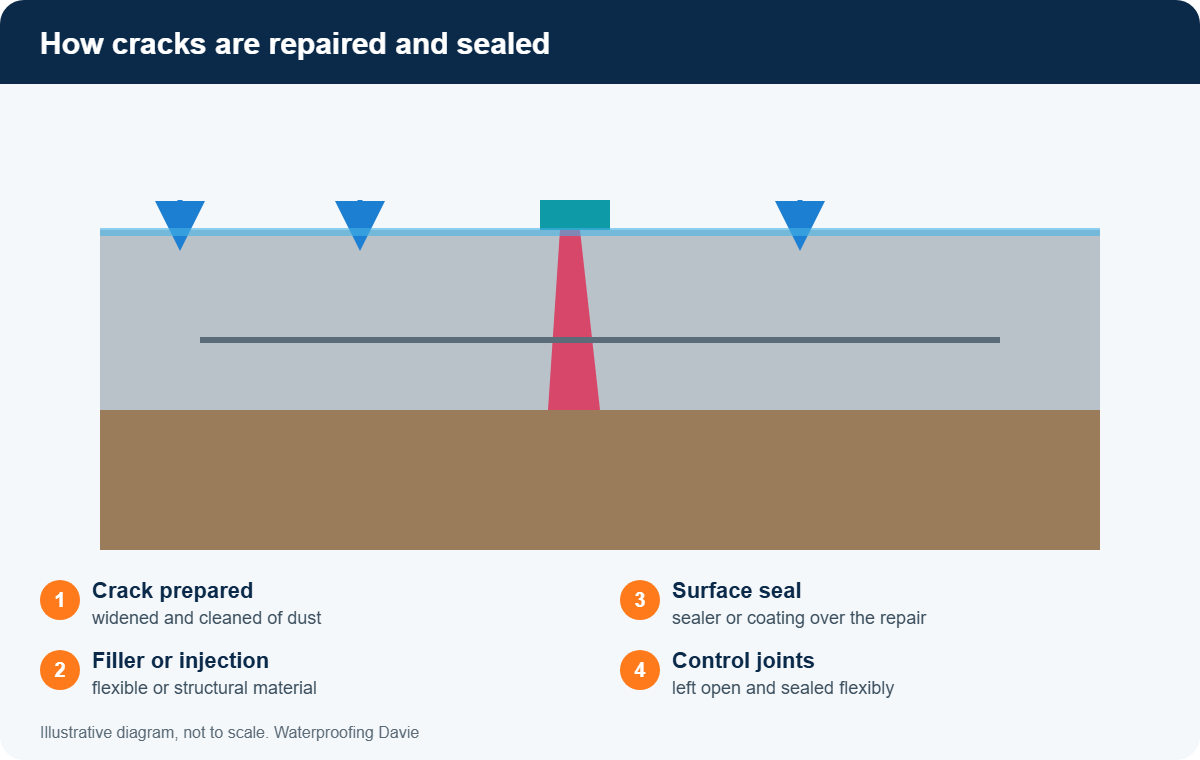
Concrete sealing and crack repair protects slabs, driveways, patios, walkways and steps. Cracks are cleaned and filled with a flexible or structural material, joints are re-sealed and a sealer or coating is applied to reduce water absorption, staining and surface wear. It helps prevent water from reaching the soil and reinforcing steel and keeps surfaces looking better for longer. Call (754) 258-3576 or text photos for a written estimate from an independent local contractor.
Concrete is part of nearly every building. See our overview of concrete protection and waterproofing in Davie.
Signs Your Concrete Needs Sealing or Repair
Look at the surface after rain and again once it dries.
Cracks and gaps
Cracks that widen, branch or hold water, and joints with missing filler, let moisture into the slab and soil.
Dark, blotchy or stained surfaces
Water absorption, mildew-like growth, oil and rust stains show the concrete has open pores.
Scaling and flaking
Surface layers peeling away point to moisture and wear working on the concrete.
White powder or uneven slabs
Efflorescence and tilted or settled sections suggest water movement and base problems.
Why Concrete Cracks and Absorbs Water
Concrete shrinks as it cures and expands and contracts with heat. Cracks form where it is weakest, usually at joints, corners and places where the base has settled.
Even without visible cracks, concrete is full of tiny pores. In a wet climate those pores absorb water, which carries salts and dirt, feeds algae and stains the surface.
Repair plus sealing is the answer. Fill the cracks to stop larger water entry, keep joints flexible and apply a sealer to cut absorption. If the base is washing out, that problem must be fixed too.
Concrete Sealers and Repair Materials Compared
Different products solve different problems.
| Product | What it does | Best for | Watch out for |
|---|---|---|---|
| Penetrating sealer (silane or siloxane) | Soaks in and repels water without changing the look much | Driveways, walkways and exposed concrete | Does not fill cracks |
| Acrylic film-forming sealer | Forms a protective film with color enhancement | Patios and decorative concrete | Can wear and need recoating |
| Polyurethane or polyaspartic sealer | Tough, abrasion-resistant film | Heavy traffic and garages | Needs careful prep |
| Epoxy crack injection | Rigid, structural repair material | Non-moving structural cracks | Not for cracks that keep moving |
| Polyurethane crack sealant | Flexible, waterproof filler | Cracks and joints that move | Needs correct joint shape |
| Cementitious patching | Repairs spalls and surface damage | Damaged edges and surfaces | May crack without proper bond |
Ask the contractor which cracks are moving and how that changes the repair material.
Sealing and Repair by Surface
Each surface sees different loads and moisture.
Vehicles, oil and sun age driveways.
- Clean oil and stains and repair cracks
- Re-seal control joints with flexible sealant
- Apply a sealer suited to vehicle traffic
Keep the drainage slope toward the street or swale.
Patios hold furniture, plants and water.
- Repair cracks and low spots
- Clean algae and stains
- Apply a slip-resistant sealer or coating
Check where water from roofs and sprinklers lands.
Garages face oil, tire marks and moisture.
- Grind or etch the surface and fill cracks
- Apply a sealer or coating built for vehicles
- Seal the joint at the garage door
Check slab slope toward the door.
Steps are high-traffic and high-risk.
- Repair chipped edges and nosings
- Seal cracks and joints
- Use a slip-resistant finish
Safety comes before looks on stairs and landings.
Decorative surfaces need matching products.
- Clean and repair without changing the pattern
- Choose a sealer that preserves color and texture
- Plan periodic resealing
Always test in a small area first.
How Concrete Crack Repair and Sealing Works: Four Steps
A good job follows this order.
1
Inspect and map
Identify crack types, moving versus stable cracks, settlement, drainage and surface condition.
2
Prepare and repair
Clean, open and fill cracks with the right material, repair spalls and re-seal joints.
3
Clean and seal
Remove stains and growth, then apply the sealer or coating in the specified coats.
4
Cure and review
Keep the area dry and off-limits while it cures, then inspect and review maintenance and warranty terms.
Crack Types and How They Are Usually Handled
| Crack type | What it usually means | Typical response |
|---|---|---|
| Hairline surface crack | Shrinkage or temperature stress | Seal or coat to limit water entry |
| Wide, straight crack | Movement or drying stress | Fill with flexible sealant after evaluation |
| Stair-step or stepped crack | Settlement or heaving | Evaluate cause before cosmetic repair |
| Crack at a joint or edge | Joint wear and movement | Remove old sealant and reseal |
| Crack with rust stains | Steel is corroding inside | Structural evaluation and repair |
| Map or crazing cracks | Surface drying or curing issues | Clean and apply a protective coating |
Seal, Repair or Replace?
| Condition | Typical approach | Why |
|---|---|---|
| Sound slab, stains and wear | Clean and seal | Restores protection at lowest scope |
| Isolated cracks and open joints | Repair, reseal and seal | Stops water entry |
| Spalled or scaling surface | Patch or resurface, then seal | Rebuilds a protected surface |
| Heaved, settled or crumbling slab | Replace or lift and level | Cosmetic repair will not last |
| Cracks with moving structure | Engineer evaluation | Safety and structural concerns come first |
If you see cracks in walls or doors that stick, ask a licensed professional to look at the structure.
What Affects the Cost of Concrete Sealing and Repair
We do not quote prices by phone because every site differs.
| Factor | Why it matters | Effect on cost |
|---|---|---|
| Area and layout | More surface and details take more time and material | Higher with size |
| Crack length and type | Moving cracks need flexible materials and more labor | Higher |
| Surface prep | Stains, old coatings and oil add cleaning steps | Higher |
| Product selected | Sealers and coatings differ in price and life | Varies |
| Access and traffic | Cars, furniture and plants affect scheduling | Can add time |
| Warranty | Longer warranties usually require specified prep and products | Varies |
Mistakes That Shorten the Life of Sealed Concrete
- Sealing over dirt and algae. The sealer locks in stains and fails to bond.
- Using rigid filler in moving cracks. It breaks and the crack reopens.
- Skipping the joints. Open joints are the easiest path for water.
- Picking a glossy sealer for walking surfaces. It can be slippery when wet.
- Sealing damp concrete. Trapped moisture clouds and peels sealers.
- Ignoring settlement. Cosmetic repair does not fix a moving base.
- Choosing only on price. Thin products and quick prep wear out early.
Why Concrete Struggles in Davie’s Climate
Local conditions make protective work especially worthwhile.
Heavy summer rain
Frequent downpours saturate slabs and the soil under them, which can wash out base material and lead to settling.
Sun and heat
Daily heating and cooling cause expansion and contraction that open cracks and wear sealers.
Roots and irrigation
Tree roots lift slabs, and sprinklers that soak edges keep concrete wet and growing algae.
Soil and drainage
Flat lots and sandy soil can leave water standing near slabs. Pool surrounds and patios are discussed on our pool deck waterproofing page. Water that collects near slabs is covered on our drainage and water management page.
A Concrete Care Calendar for Davie
| When | What to do | Why it helps |
|---|---|---|
| Late winter to spring (Feb – Apr) | Inspect cracks, joints and sealers, and schedule repairs. | Work is done before the rainy season. |
| Rainy season (May – Oct) | Watch for ponding, new cracks and settling. | Early notice keeps repairs small. |
| Before a named storm | Clear loose items and photograph slab conditions. | Documents condition and reduces debris. |
| After a major storm | Check for washed-out edges and new cracks. | Quick repair limits damage. |
| Drier months (Nov – Jan) | Schedule sealing and joint work. | Dry weather gives the best cure. |
Concrete Sealing for Different Property Types
| Property type | Common situation | What owners usually need |
|---|---|---|
| Single-family homes | Stained driveway, cracked patio and worn walkways | Crack repair, cleaning and a suitable sealer |
| Townhomes and HOA communities | Shared walkways and uniform appearance | Approved products and phased work |
| Condominiums | Garages, ramps and common walkways | Durable sealers and slip resistance |
| Commercial properties | Parking areas, loading zones and entries | Heavy-duty systems and scheduled downtime |
| Rental properties | Turnover and safety concerns | Quick repairs and clear written scope |
What a Good Concrete Estimate Should Include
- Inspection findings: photos and notes on crack type, settlement and drainage.
- Repair scope: crack filling, joint work and spall patching.
- Surface preparation: cleaning, grinding and moisture checks.
- The exact product: name, number of coats, finish and a sample.
- Slip resistance: how the finish gets traction when wet.
- Protection and cleanup: how plants, vehicles and nearby surfaces are protected.
- Schedule and cure time: when the area can be used again.
- Warranty: what is covered, for how long and what voids it.
Caring for Sealed Concrete
- Sweep and rinse regularly and clean spills and oil quickly.
- Avoid harsh de-icers, acids and high-pressure washing unless approved by the product maker.
- Keep gutters, drains and sprinklers pointed away from slabs.
- Re-check cracks and joints each spring and after storms.
- Plan to reseal on the interval recommended for the product.
- Keep product names and warranty paperwork together.
Questions to Ask Before You Approve Concrete Work
| Question | Why it matters | What a good answer sounds like |
|---|---|---|
| Are these cracks moving? | Moving cracks need flexible materials | The contractor explains how they checked |
| What material will you use in the cracks? | Wrong filler fails fast | A specific flexible or structural product is named |
| How will you handle joints? | Open joints let water in | Old sealant removed and replaced |
| What sealer and how many coats? | Product choice determines life | Product, coats and finish are in writing |
| How will the surface feel when wet? | Safety on walking surfaces | Anti-slip finish is described and sampled |
| What does the warranty cover? | Terms vary widely | Written terms with exclusions listed |
Concrete, Drainage and the Soil Beneath
Concrete sits on soil, and soil moves with water. When rain runs under a slab or collects at its edge, the base can wash out, voids form and cracks grow. Sealing the top of the slab helps, but it works best when water is directed away from the concrete.
Look at where the water goes. Downspouts that empty beside a slab, sprinklers that spray the edge and low spots that hold puddles all feed water into the base. Fixing these often does more for a slab than any sealer.
Choosing Between a Clear Sealer and a Coating
The biggest decision on most concrete jobs is whether to keep the natural look with a sealer or to add a thicker coating.
When a penetrating sealer makes sense
If the concrete is sound, mostly uncracked and you like how it looks, a penetrating sealer reduces water absorption and staining without adding a film that can peel. It is a good fit for driveways and walkways that need protection more than decoration.
When a coating makes sense
If the surface is stained, patched or uneven, or you want color and texture, a film-forming sealer or coating gives a more uniform look and can bridge hairline cracks. It needs more preparation and periodic recoating.
When neither is the right first step
If slabs are heaving, crumbling or sitting in standing water, repair the cause before sealing. A sealer over a failing base only hides the problem for a short time.
Concrete Sealing Timeline
Every project differs, but most follow this general pattern.
| Stage | What happens | General notes |
|---|---|---|
| Estimate and inspection | Walk the area, document cracks and discuss options | Photos and notes become the written scope |
| Preparation | Clean, grind or etch and repair cracks and joints | Often the most important stage |
| Sealing or coating | Apply the specified product in the specified coats | Weather and humidity affect timing |
| Cure | Keep traffic and water off the surface | Follow the product maker’s cure times |
| Final walkthrough | Inspect the finish and review care and warranty documents | Keep paperwork for future touch-ups |
Preparing Concrete Properly: Why It Decides Everything
Nearly every sealer or crack repair that fails early fails because of preparation. A good contractor spends more time on the surface than on the product.
Cleaning
Dirt, algae, oil, old sealer and efflorescence all block bonding. Surfaces are cleaned with methods matched to the stain, and oil is treated before sealing.
Profile
Dense or glossy concrete may need light grinding or etching so that the product can grip. Sealers on slick surfaces peel.
Moisture
Concrete that is damp inside can cloud or blister a sealer. Contractors often wait for a dry period and check moisture before coating.
Cracks and joints first
Repairs are made before the sealer goes on so that the sealer protects the repair instead of being cut by an open crack.
Weather windows
Sealing is best on dry, mild days with no rain expected during cure. In Davie that often means scheduling work in the drier months or watching the forecast closely.
Who Does the Work
Waterproofing Davie is a local referral service. We do not perform the work ourselves. Independent contractors do the work and provide their own written estimate, warranty terms, license and insurance details. Before you approve work, ask the contractor to confirm their Florida license and insurance in writing and verify both with the State of Florida. Structural cracks, settled slabs and drainage problems are sometimes best evaluated by a licensed concrete or structural professional first.
Frequently Asked Questions About Concrete Sealing and Crack Repair in Davie
Related Waterproofing Services
Foundation and slab waterproofing
Address moisture rising through slabs and foundations.
Get a Concrete Sealing Estimate in Davie
Tell us what the concrete is, where the cracks or stains are and how the area is used. Photos help. You will get a plain-language explanation and a written estimate before any work starts.