
Home › Services › Stucco Repair
Stucco Repair in Davie, FL
Stucco is the weatherproof skin on most Davie homes, but cracks and failed paint let rain reach the block behind it. Repairing cracks and restoring the coating keeps water out and protects the walls and interior.
Local referral to independent contractors · Written estimate before work starts · Emergency leaks welcome
Stucco Walls at a Glance
~60 in.
of rain a Davie wall faces in a typical year
Block + stucco
the most common wall system in South Florida
Jun 1 – Nov 30
storm season, when wind-driven rain tests every crack
Dry surface
needed before patching and painting
Quick Answer: Should I Repair My Stucco Cracks?
Yes, once they are open enough to hold a pencil line or are growing, or when you see stains, bubbling paint or damp walls inside. Water entering through cracks can soak the block, corrode metal lath and damage interior finishes, and it can lead to mold. Repair means cleaning and filling the crack with the right material, matching the texture, and sealing the surface with a flexible coating. Call (754) 258-3576 or text photos for a written estimate from an independent local contractor.
Walls are only one entry point for water. For roofs, windows, slabs and drainage, see our full set of exterior waterproofing services in Davie.
Signs Your Stucco Needs Repair
Check walls on a dry day and again after rain. The sooner you catch a problem, the simpler the repair.
Cracks and gaps
Hairline cracks, wider cracks at window corners and long horizontal cracks can all let water in.
Stains and bubbling paint
Dark streaks, green growth, bubbling or peeling paint and white powder suggest moisture is moving through the wall.
Hollow or loose areas
A hollow sound when tapped, bulges or pieces falling away mean the stucco has lost its bond.
Rust stains and interior damage
Rust-colored streaks point to corroding metal lath, and damp patches or musty smells inside show water has reached the interior.
How Water Gets Through Stucco
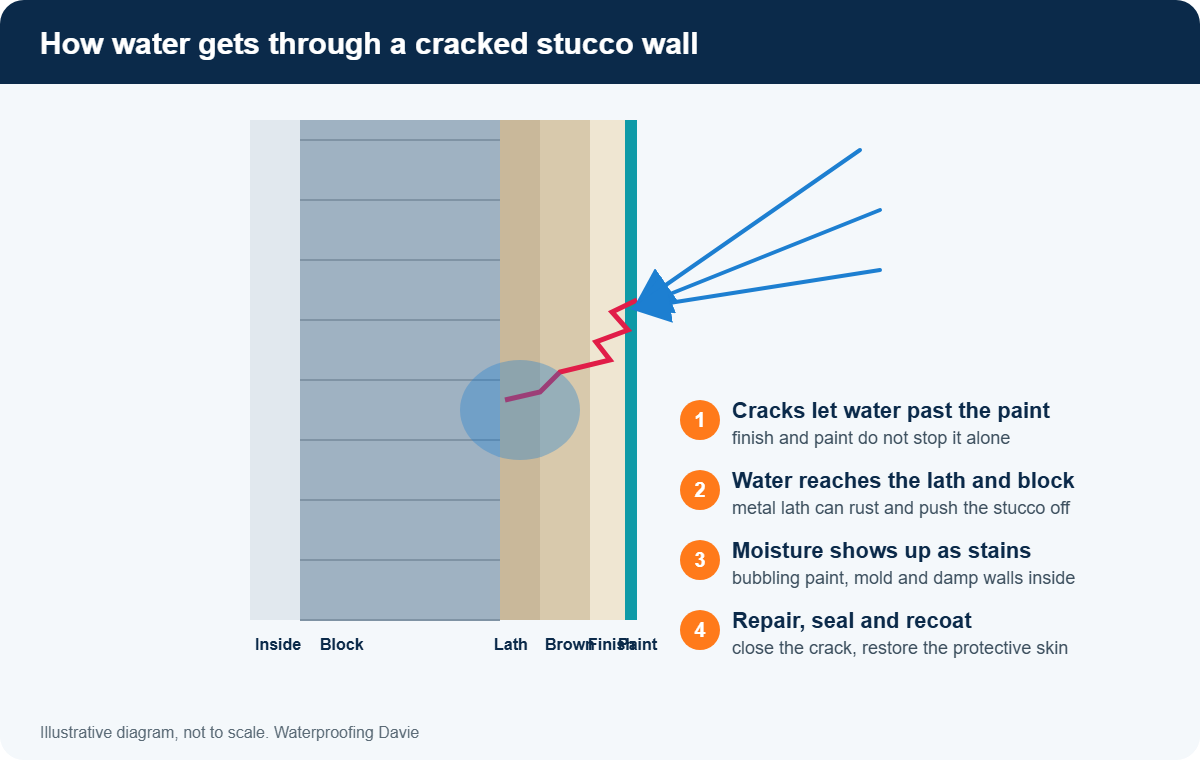
Stucco is a cement-based coating, not a sealed membrane. In a typical Florida wall it is applied over block or lath, in layers, and then painted. Paint and the finish coat do much of the day-to-day water resistance, so a crack through them opens a path to everything behind.
Once water is past the surface, it soaks the block, which can carry moisture a long way. If the wall has metal lath, water can corrode it, and rust expands, which pushes the stucco off the wall and makes cracks larger. Moisture that dries and returns also leaves salts behind, which appear as white powder.
Windows and doors are the most common entry points, because stucco meets a different material there and cracks usually start at the corners. If your leaks cluster around openings, see our guide to window and door caulking in Davie.
Types of Stucco Cracks and What They Usually Mean
Not all cracks are equal. This table helps explain what a contractor may be looking at, though only an inspection can say for sure.
| Crack type | What it looks like | Common causes | Usual approach |
|---|---|---|---|
| Hairline or craze cracking | Fine web of cracks across the surface | Shrinkage as stucco cures, sun and temperature changes | Clean and coat with elastomeric paint |
| Vertical or horizontal cracks | Straight lines along a wall | Control joint absence, shrinkage and wall movement | Rout, fill with flexible patch, add control joint if needed |
| Diagonal cracks at corners | Angled lines from window and door corners | Stress concentration at openings | Repair, reinforce and seal corners |
| Stair-step cracks | Cracks following block joints | Settlement or movement in the wall behind | Have the cause evaluated before cosmetic repair |
| Spider or impact cracks | Radiating cracks from one point | Impact or a localized weakness | Patch and match the texture |
| Cracks with rust stains | Streaks of rust from cracks | Corroding lath behind the stucco | Open up, treat or replace lath, then patch |
Wider or growing cracks, or cracks in a stair-step pattern, should be looked at by a professional before cosmetic repair.
Stucco Repair by Problem
Choose the problem closest to what you see.
Most stucco repair begins with cracks.
- Clean the crack and remove loose material
- Rout or open the crack if needed so filler can bond
- Fill with a flexible patch or cementitious product suited to the crack
- Texture to match and apply a primer and flexible coating
Sealing the crack and recoating the wall keeps small cracks from becoming wide ones.
Stucco that has separated from the wall is a safety and water risk.
- Tap test the wall to map the hollow area
- Remove loose stucco back to a sound edge
- Check the substrate and lath for moisture and corrosion
- Patch in layers and blend the texture
Large areas of loose stucco may point to replacement of that section.
Dark streaks and green growth usually follow moisture or shade.
- Identify where water is coming from
- Clean with the right method and avoid harsh pressure on weak stucco
- Repair cracks and seal, then recoat
Cleaning alone does not fix the cause.
A flexible, breathable coating helps protect repaired stucco.
- Repair and cure patches first
- Prime as the product requires
- Apply the specified number of coats of elastomeric or masonry paint
Painting an entire wall avoids visible patches.
How a Stucco Repair Works: Four Steps
A thorough job follows this sequence. It matches our waterproofing process of inspect, fix, protect and document.
1
Inspect and map
Check cracks, hollow areas, stains and openings, measure moisture where needed and photograph findings.
2
Open and clean
Remove loose material, clean cracks and treat any exposed metal or damp areas before filling.
3
Patch and texture
Fill and patch in layers with compatible materials, then match the texture and blend it into the wall.
4
Prime, coat and document
Prime, apply the specified coating, allow it to cure and provide photos and written warranty terms.
Repair Materials Compared
The right material depends on the crack and the surface.
| Material | What it does | Best for | Watch out for |
|---|---|---|---|
| Cementitious patch | Hard, cement-based repair product | Larger holes, loose areas and rebuilding thickness | Can crack if the cause of movement is not fixed |
| Elastomeric crack filler | Flexible, paintable filler | Fine to moderate cracks that move slightly | Needs proper cleaning and prep |
| Polyurethane or hybrid sealant | Flexible joint sealant | Control joints and transitions to windows | Not a substitute for repair of cracks in the field |
| Elastomeric paint | Thick, flexible coating that bridges hairline cracks | Coating entire walls after repairs | Needs a clean, dry, sound surface |
| Bonding agent and primer | Helps new material bond to old | Patches and recoated surfaces | Compatibility with the finish coat |
Matching Texture and Color
A repair that is visible from the street is a poor repair. Stucco finishes vary, and matching them takes practice.
| Finish | How it looks | Matching tip |
|---|---|---|
| Dash or spatter | Rough, irregular dots | Patch must be flicked at the same density |
| Sand or float | Fine, even grain | Match the sand size and float technique |
| Knockdown | Raised blobs flattened with a trowel | Timing of the knockdown matters |
| Skip trowel | Smooth with trowel marks | Blend the pattern by hand beyond the patch |
| Smooth or Santa Barbara | Flat or lightly swirled | Feather edges wide to avoid visible lines |
Even when texture matches, new patches can look different once painted. Repainting the whole wall, or at least a full elevation, avoids visible patches.
Repair, Recoat or Replace?
| Option | Best when | Limits |
|---|---|---|
| Crack repair and sealing | Isolated cracks in an otherwise sound wall | Does not fix widespread loose stucco |
| Patch and repaint | Several repairs plus faded or failing paint | Underlying movement, if any, still needs attention |
| Section replacement | Loose, saturated or corroded areas | Higher cost, matching issues and possible permit |
| Full recoat or restoration | Overall weathering and many cracks but sound stucco | Not for damaged lath or wall behind |
What Affects the Cost of Stucco Repair
Every wall is different, so we do not quote by phone. These are the main factors.
| Factor | Why it matters | Effect on cost |
|---|---|---|
| Extent and type of damage | More cracks and loose areas add time and material | Higher with extent |
| Hidden moisture or lath damage | Open-up work and lath repair add scope | Higher |
| Height and access | Two-story and tall walls need scaffolding or lifts | Higher |
| Texture and color matching | Matching takes more time and may require repainting | Higher |
| Coating specification | Different products and coats cost differently | Varies |
| Permits and approvals | Some work needs a permit or HOA approval | Adds time and some cost |
Mistakes That Make Stucco Problems Worse
- Caulking over a moving crack. The caulk fails and leaves a visible line.
- Painting over damp stucco. Paint bubbles and traps moisture.
- Pressure washing weak stucco. High pressure can force water in and remove loose finish.
- Ignoring stair-step or growing cracks. These can signal movement that needs evaluation.
- Using the wrong patch mix. A patch that is too hard or too soft cracks or falls off.
- Choosing only on price. A low estimate that skips prep and sealing often costs more later.
A Stucco Care Calendar for Davie
| When | What to do | Why it helps |
|---|---|---|
| Late winter to early spring (Feb – Apr) | Inspect walls, seal cracks and recoat where needed. | Walls are protected before the rainy season. |
| Rainy season (May – Oct) | Watch for new cracks and stains after heavy rain, and keep gutters and sprinklers from soaking walls. | Early notice keeps repairs small. |
| Before a named storm | Photograph the condition of walls and openings. | Documents condition for insurance. |
| After a major storm | Check for new cracks, loose stucco and damp interior walls. | Quick repair stops water entering. |
| Drier months (Nov – Jan) | Schedule patching, painting and recoating. | Dry weather gives the best cure. |
Why Stucco Problems Are Common in Davie
Several local conditions explain why Davie walls crack, stain and grow algae.
Heavy rain and humidity
Months of rain and high humidity keep walls damp, which encourages cracks to take in water and algae to grow in shaded areas.
Heat and movement
Strong sun heats walls each day, and they expand and contract, which creates fine cracks over time.
Storm winds
Wind-driven rain pushes water into cracks, around windows and under trim, and storm vibration can open existing cracks.
Irrigation and landscaping
Sprinklers that hit walls and plants that touch stucco keep surfaces wet. Adjusting sprinklers is a free way to protect your walls.
Foundation and soil movement
Soil movement and settlement can cause cracks, especially at corners and openings. If cracks follow the slab or floor level, see our page on foundation and slab waterproofing.
How to Prepare and What to Ask
- Take dated photos and mark cracks you have noticed.
- Check your HOA rules for colors, textures and approvals.
- Trim plants away from walls and adjust sprinklers.
- Ask for a written scope that lists materials, number of coats, texture matching and cleanup.
- Confirm who handles permits and what the warranty covers.
- Ask whether the whole wall will be painted to avoid a patchy look.
Stucco Repair for Different Property Types
| Property type | Common situation | What owners usually need |
|---|---|---|
| Single-family block homes | Cracks at window corners, faded paint and algae on shaded walls | Crack repair, sealing and a full recoat of affected elevations |
| Townhomes and HOA communities | Shared walls and uniform color rules | Matching texture and color, approvals and phased repairs for the whole building |
| Condominiums and multi-story buildings | Tall walls, balconies and many openings | Access planning, balcony edge and slab-edge repair, documentation for the board |
| Commercial and retail buildings | Large stucco fronts, parapets and signage penetrations | Sealing around penetrations, recoating and minimal disruption to business hours |
| Older homes | Settlement cracks, patched repairs and missing control joints | Evaluation of cause, repair of lath and stucco, and a new coating system |
What a Good Stucco Repair Estimate Should Include
Estimates can look alike and still cover very different work. Ask each contractor to put these items in writing so you can compare them fairly.
- Inspection findings: photos, a map of cracks and hollow areas, and any moisture readings.
- Scope of repair: which cracks, areas and openings will be repaired and how.
- Materials: patch, filler, sealant, primer and paint products by name.
- Texture and color matching: how the patch will be blended, and whether whole walls will be repainted.
- Coating specification: number of coats and coverage, and how long each coat must cure.
- Prep and protection: how windows, plants, cars and walkways will be protected, and how cleanup is handled.
- Schedule and weather plan: expected duration and what happens if it rains.
- Warranty: what is covered, for how long and what voids it.
- Permit and approval responsibility: who handles permits and HOA paperwork.
If an estimate lists only a price per wall, ask for more detail before you decide.
Stucco and Hurricane Season
Storms test stucco in several ways. Wind-driven rain is pushed into cracks and around windows, strong gusts and flying debris can cause impact damage, and vibration during a storm can widen existing cracks. Walls that are sealed and freshly coated shed this water much better than walls with open cracks.
Before the season starts, walk around the building and look at window corners, wall bases and any previous patches. After a storm, look for new cracks, loose stucco and damp spots on interior walls. Photograph anything you find with a date, because documentation helps with insurance and with the contractor’s inspection.
Caring for Stucco After Repair
A repaired wall lasts longer with a few habits.
- Keep sprinklers pointed away from walls, and keep soil and mulch below the stucco line at the base.
- Trim plants and vines so they do not touch the wall.
- Wash walls gently, as the paint manufacturer recommends, and avoid high pressure that can damage the finish.
- Check cracks, window corners and wall bases each spring and after major storms.
- Keep the estimate, product data sheets, color formula and warranty together so touch-ups match.
- Plan to recoat on a regular schedule, since paint is the first line of defense and it wears with sun and rain.
Who Does the Work
Waterproofing Davie is a local referral service. We do not perform the work ourselves. Independent contractors do the work and provide their own written estimate, warranty terms, license and insurance details. Before you approve work, ask the contractor to confirm their Florida license and insurance in writing and verify both with the State of Florida.
Frequently Asked Questions About Stucco Repair in Davie
Related Waterproofing Services
Get a Stucco Inspection in Davie
Tell us where the cracks or stains are, how long you have seen them and whether it has leaked inside. Photos help. You will get a plain-language explanation and a written estimate before any work starts.