
Home › Services › Foundation Repair
Foundation Repair and Slab Waterproofing in Davie, FL
Most Davie homes sit on concrete slabs in wet, low-lying ground. Cracks, joints and poor drainage let moisture rise into floors and wall bases. Foundation waterproofing seals those paths and moves water away. Foundation repair in Davie, FL starts with finding where the moisture enters.
Local referral to independent contractors · Written estimate before work starts · Emergency leaks welcome

Slabs and Foundations at a Glance
Slab-on-grade
the most common foundation type in Broward County homes
~60 in.
of rain soaks South Florida soil in a typical year
High water table
keeps soil wet for much of the year
Engineer first
for wide, growing or stair-step cracks
Quick Answer: What Is Foundation Repair in Davie, FL?
Foundation and slab waterproofing manages water around and under a building. It includes sealing cracks and joints in slabs and walls, treating floors and wall bases for moisture, applying waterproof coatings to stem walls, and improving grading and drainage so water moves away. It is separate from structural repair: if a crack is wide, growing or shows movement, a licensed structural engineer should evaluate it first. Call (754) 258-3576 or text photos for a written estimate from an independent local contractor.
Foundations are only part of a building’s water defense. For roofs, walls, windows and drainage, see the full range of waterproofing services we refer across Davie.
Signs of Moisture at the Slab and Wall Base
Check these on a dry day and after heavy rain.
Damp or cool floor spots
Patches that stay damp, feel cool or darken after rain can show moisture rising through the slab.
Lifting or stained flooring
Buckled laminate or wood, loose tile, curling vinyl and stains at wall bases suggest moisture under the floor.
White powder and musty smell
White mineral deposits on concrete or block, and a musty odor in a closet or garage, point to moisture.
Cracks and gaps
Cracks in slabs, floor-to-wall gaps and cracks at the base of walls are common routes for water.
How Moisture Reaches a Slab-on-Grade Home
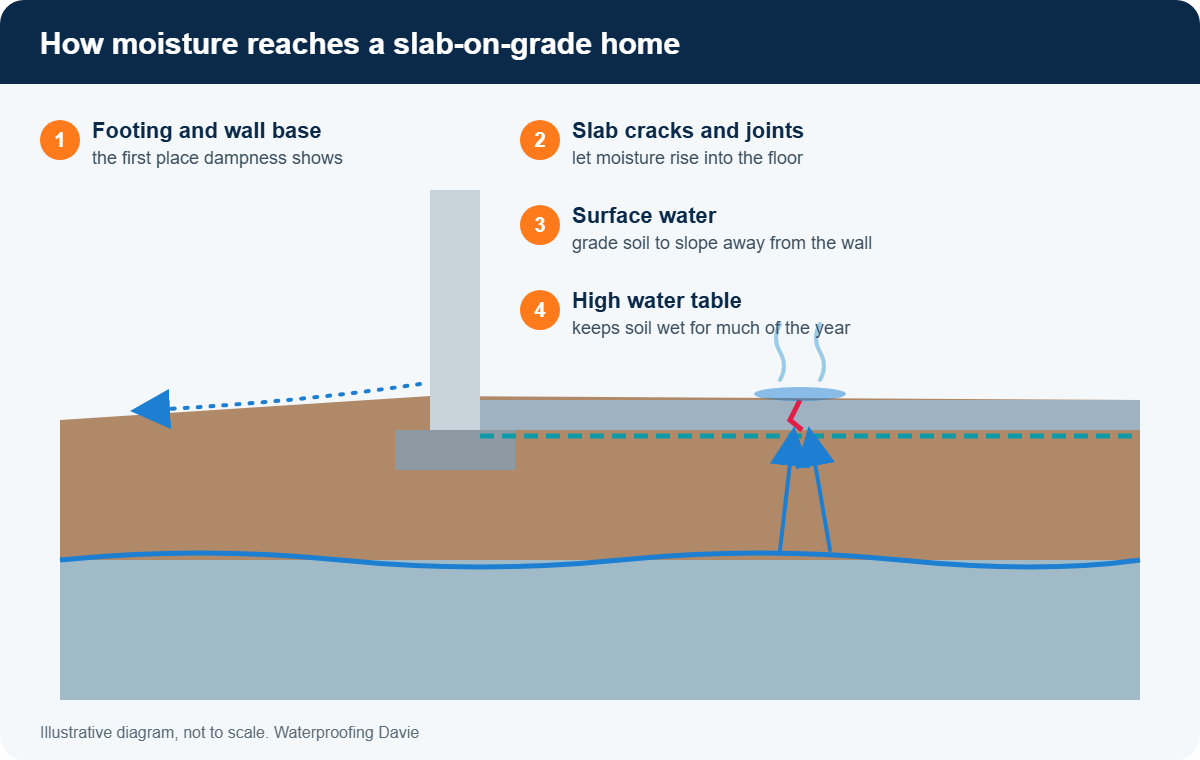
Concrete looks solid but is porous, and ground conditions around Davie are wet for much of the year. Water reaches a slab in several ways: from the surface, as rain and irrigation run toward the building, and from below, as groundwater and soil moisture rise through cracks, joints and the concrete itself.
In a home with a plastic vapor barrier under the slab, moisture is reduced but not always eliminated. Barriers can be torn, missing or bypassed at cracks and plumbing penetrations. Wall bases are especially vulnerable, because the slab, the wall and the footing meet there.
Surface drainage is often the cheapest fix. Soil that slopes toward the house, gutters that discharge next to the wall and sprinklers that soak the base all add water that the slab and wall must resist. If water is also entering through exterior walls, see our page on stucco and wall-base cracks.
Types of Concrete Cracks and What They May Mean
This table is a guide only. Concerning cracks need professional evaluation.
| Crack type | What it looks like | Common causes | Usual approach |
|---|---|---|---|
| Hairline shrinkage cracks | Fine, short cracks that do not widen | Concrete shrinkage during curing | Seal to keep water out |
| Straight cracks through the slab | Longer cracks, usually with little offset | Shrinkage and control joint absence | Seal or inject, then monitor |
| Cracks at corners and openings | Diagonal cracks near doors and columns | Stress at corners | Seal and monitor |
| Stair-step cracks in block walls | Cracks following block joints | Movement or settlement | Engineer evaluation first |
| Cracks with offset | One side higher than the other | Settlement, soil washout or heave | Engineer evaluation first |
| Cracks that leak | Water or dampness visible at the crack | Groundwater pressure or drainage issues | Seal or inject, then address drainage |
Wide cracks, cracks that grow, offsets and doors or windows that no longer operate normally are signs to call an engineer.
Slab and Foundation Waterproofing by Problem
Choose the problem closest to what you see.
Sealing cracks stops water entry and keeps cracks from collecting dirt and moisture.
- Clean and open the crack as needed
- Seal with a flexible sealant or inject with a suitable resin
- Treat the surrounding area and flooring if affected
The right material depends on whether the crack moves.
Floor dampness often comes from moisture vapor rising through the concrete.
- Test the slab for moisture before choosing a treatment
- Apply a suitable moisture-control sealer or membrane under flooring
- Improve drainage and humidity control in the room
Treatment choice depends on the flooring and moisture levels.
The joint where walls meet the slab is a common seepage point.
- Seal the floor-to-wall joint and cracks at the base
- Apply a waterproof coating to exposed stem walls
- Check grading, gutters and sprinklers beside the wall
Coatings should be compatible with the surface and any paint.
Garage floors and patios are exposed to rain and washing.
- Seal joints and cracks
- Apply a sealer or coating to reduce water entry
- Fix pooling and drainage problems
These areas often show white powder, stains and slick surfaces.
Slab and Foundation Waterproofing Methods Compared
Methods differ in purpose and cost. Ask the contractor why a method fits your problem.
| Method | What it does | Best for | Limits |
|---|---|---|---|
| Crack routing and sealing | Opens the crack and fills it with flexible sealant | Hairline to narrow cracks | Does not restore strength |
| Polyurethane injection | Expands to stop water in leaking cracks | Active leaks and damp cracks | Not a structural repair |
| Epoxy injection | Bonds and fills cracks with a rigid resin | Dry, stable cracks where bonding is desired | Not suited for moving cracks; may need engineering |
| Penetrating or surface sealers | Reduce water and vapor entry into concrete | Garage floors, patios and dry slabs | Do not fix leaks through cracks |
| Exterior waterproof coatings | Seal exposed stem walls and below-grade surfaces | Wall bases and retaining walls | Must be applied to sound, clean surfaces |
| Drainage improvements | Move surface and shallow groundwater away | Soil sloping to walls and ponding near the slab | May need permits and design |
How Foundation and Slab Waterproofing Works: Four Steps
A thorough job follows this order, matching our waterproofing process.
1
Inspect and test
Look at cracks, floors, wall bases, grading and gutters, and use moisture tests where helpful.
2
Find the source
Determine whether water comes from the surface, the ground or both, and rule out plumbing leaks.
3
Seal and treat
Seal cracks and joints, treat floors or wall bases, and apply coatings suited to the surface and the cause.
4
Improve drainage and document
Correct grading and downspouts where needed, then provide photos, notes and written warranty terms.
When to Call an Engineer First
Waterproofing is about water. Some conditions call for a structural opinion before any sealing is done.
- Cracks wider than a coin edge, or cracks that grow over weeks or months
- Stair-step cracks in block walls, especially with a vertical offset
- Doors and windows that suddenly stick, or gaps that open above them
- Floors that slope, or parts of a slab sitting higher or lower than others
- Sinkholes, voids or washed-out soil near the foundation
- Any damage after a storm, flood or nearby construction that affects the structure
A licensed structural engineer can say whether movement is active and what repair is needed. Waterproofing contractors can then seal and protect the repaired structure. Do not seal a moving crack as though it were a leak.
What Affects the Cost of Foundation and Slab Waterproofing
Costs vary widely, so we do not quote prices by phone. These factors drive estimates.
| Factor | Why it matters | Effect on cost |
|---|---|---|
| Length and number of cracks | More cracks mean more labor and material | Higher with extent |
| Method chosen | Injection, coatings and drainage cost differently | Varies |
| Access | Interior finishes, furniture and tight spaces add time | Higher |
| Flooring and finishes | Floors may need to be removed and replaced | Higher |
| Drainage work | Regrading, drains and downspout extensions add scope | Higher |
| Permits and engineering | Some work needs drawings or permits | Adds time and cost |
Mistakes That Make Moisture Problems Worse
- Painting over damp concrete. Paint and sealers fail on a wet surface and trap moisture.
- Sealing a moving crack as if it were a leak. The sealant tears, and the cause remains.
- Ignoring drainage. Soil sloping to the wall and downspouts at the base keep adding water.
- Overwatering near walls. Irrigation that hits the wall base soaks the slab edge.
- Installing flooring over a wet slab. Moisture lifts and stains flooring and breeds mold.
- Choosing only on price. A quick surface sealer without finding the source rarely lasts.
Foundation and Slab Waterproofing for Different Property Types
| Property type | Common situation | What owners usually need |
|---|---|---|
| Single-family slab homes | Damp floors, wall base moisture and garage staining | Crack sealing, floor treatment and drainage fixes |
| Townhomes and condos | Ground-floor units and shared walls | Association coordination, documented findings and phased scopes |
| Homes with additions | Joints between old and new slabs | Joint sealing and drainage around the addition |
| Rural and equestrian properties | Barn floors, outbuildings and large paved areas | Slab sealing, drainage and runoff management |
| Commercial and retail | Warehouse floors, loading docks and storefront slabs | Slab sealers, joint sealing and drainage |
A Slab and Drainage Care Calendar for Davie
| When | What to do | Why it helps |
|---|---|---|
| Late winter to early spring (Feb – Apr) | Check grading, gutters, downspouts and wall bases, and seal cracks. | Fixes are in place before the rainy season. |
| Rainy season (May – Oct) | Watch floors and wall bases after heavy rain and keep gutters clear. | Early notice limits moisture damage. |
| Before a named storm | Clear drains and downspouts and photograph the condition of slabs and walls. | Helps drainage and documents condition. |
| After a major storm | Look for new cracks, standing water and damp floors. | Quick action reduces mold risk. |
| Drier months (Nov – Jan) | Schedule sealing, coatings and drainage work. | Concrete and sealers need dry conditions. |
Why Foundation Moisture Is Common in Davie
Several local conditions explain why moisture shows up in slabs and wall bases.
A high water table
Much of Broward County sits close to the water table, which rises during the rainy season. Wet soil stays in contact with slabs and footings.
Flat land and heavy rain
Water does not run off flat sites quickly. Downpours pond near buildings and soak into the soil.
Humidity
Warm, humid air drives moisture through concrete even without liquid water, and cool indoor surfaces cause condensation.
Irrigation and landscaping
Sprinklers and planting beds next to walls add water at the most vulnerable point.
Older slabs and additions
Older homes may have no vapor barrier, and joints between old and new slabs are common leak paths. If water is entering at several places at once, see our page on emergency leak repair.
What a Good Estimate Should Include
- Inspection findings: photos, moisture readings and a map of cracks and damp areas.
- Cause: a plain-language explanation of where the water comes from.
- Scope and method: what will be sealed, treated or coated, and why that method suits the problem.
- Products: named materials and data sheets.
- Drainage work: grading, gutters, downspouts or drains, if any.
- Structural notes: whether an engineer should evaluate anything first.
- Schedule and weather plan: expected duration and drying times.
- Warranty: what is covered, for how long and what voids it.
- Permit responsibility: who handles permits, if needed.
Flooding vs. Seepage: Two Different Problems
People often use the word flooding for any water on the floor. The two problems have different causes and different solutions, so it helps to name which one you have.
| Seepage and dampness | Flooding | |
|---|---|---|
| What it looks like | Damp spots, cool floors, stains, musty smell, white powder | Standing water that covers floors or spreads across rooms |
| Typical cause | Cracks, joints, wet soil, high water table, humidity and drainage | Heavy rain, surge, blocked drainage or an overwhelmed canal or system |
| Speed | Slow, often over days or weeks | Fast, often within hours |
| Typical response | Find the source, seal cracks, treat floors and improve drainage | Remove water, dry the building, document damage and contact your insurer |
| Waterproofing helps by | Reducing moisture entry and keeping it from returning | Limiting some seepage, but elevation, drainage and flood protection matter more |
| Who to call | A waterproofing contractor through us | A water extraction service, and your insurer, and us for follow-up sealing |
If you live in a flood zone, ask your insurer about flood coverage and check local requirements. Standard homeowners policies often exclude flood.
How Moisture in a Slab Is Tested
Guessing about moisture is a common reason repairs fail. A thorough contractor tests before choosing a treatment, and these are some of the methods used.
| Test | What it shows | Good to know |
|---|---|---|
| Visual and touch check | Damp spots, staining, white powder and cracks | A starting point, not a measurement |
| Plastic sheet test | Condensation under a taped sheet hints at moisture vapor from the slab | Simple, but only a rough indicator |
| Moisture meter readings | Surface and shallow moisture in concrete, wood and drywall | Quick, helpful for mapping damp areas |
| Calcium chloride test | Rate of vapor emission from a slab over a set time | Used before installing flooring |
| In-slab relative humidity probes | Moisture inside the concrete | Often required by flooring manufacturers |
| Thermal imaging | Temperature differences that may reveal wet areas | Supports other tests, does not replace them |
Ask what testing your contractor does and how the results will shape the treatment. Flooring manufacturers often specify allowed moisture levels, and installing flooring over a wet slab can void warranties.
Protecting Your Slab Day to Day
Some of the best protection costs nothing. Use this list between professional visits.
- Check that soil near walls slopes away from the building and that mulch and planting beds do not trap water against the wall.
- Extend downspouts so that roof water lands several feet from the foundation.
- Point sprinklers away from walls, and avoid running irrigation too long near the slab edge.
- Keep indoor humidity under control with air conditioning, dehumidifiers and ventilation.
- Move stored items off garage floors and away from walls so damp spots are easy to see.
- Use area rugs and furniture pads carefully on damp floors, since they can trap moisture.
- Walk the property after heavy rain and note any pooling, new cracks or damp spots.
Who Does the Work
Waterproofing Davie is a local referral service. We do not perform the work ourselves. Independent contractors do the work and provide their own written estimate, warranty terms, license and insurance details. Structural repair, where needed, should be evaluated by a licensed structural engineer. Before you approve work, ask the contractor to confirm their Florida license and insurance in writing and verify both with the State of Florida.
Frequently Asked Questions About Foundation Waterproofing in Davie
Related Waterproofing Services
Get a Foundation and Slab Moisture Inspection in Davie
Tell us where you see dampness, cracks or staining and how long you have noticed it. Photos help. You will get a plain-language explanation and a written estimate before any work starts.