
Home › Services › Pool Deck Waterproofing
Pool Deck Waterproofing in Davie, FL
Sun, chlorine, splash and months of rain are hard on pool decks. Waterproofing seals cracks and joints, protects the slab and adds a durable, slip-resistant surface so your deck stays safe and looks better for longer.
Local referral to independent contractors · Written estimate before work starts · Emergency leaks welcome

Pool Decks at a Glance
~60 in.
of rain a Davie pool deck takes in a typical year
Year-round
sun and heat make coatings and sealants work hard
Joints first
most deck leaks start at joints and cracks
Slip resistance
matters as much as waterproofing around water
Quick Answer: What Is Pool Deck Waterproofing?
Pool deck waterproofing protects the concrete or paver surface around a pool from water, sun and chemicals. It includes sealing cracks, replacing failed expansion and coping joints, repairing damaged areas and applying a coating or sealer that is slip-resistant and suited to heat and wet feet. It helps prevent water from soaking into the slab, staining, flaking and further cracking. Call (754) 258-3576 or text photos for a written estimate from an independent local contractor.
Pool decks are one of many outdoor surfaces we help with. See our full list of pool and outdoor waterproofing services across Davie.
Signs Your Pool Deck Needs Waterproofing
Walk the deck on a dry day and look at the joints, edges and surface.
Cracks in the deck
Hairline cracks collect water, and wider ones can show movement or washed-out base material.
Failed joints and gaps
Dried, cracked or missing sealant at expansion joints and at the coping lets water into the slab.
Stains, flaking and efflorescence
White powder, rust marks, peeling coatings and pitted concrete show water is moving through the deck.
Standing water and slippery spots
Puddles that remain after rain, and algae-slick areas, point to slope or drainage problems.
How Water Damages a Pool Deck
A pool deck is a large, flat slab in full sun, getting splashed, rained on and hit by sprinklers. Water that enters through cracks and joints soaks the concrete and the soil below. That soil can wash out and settle, which makes cracks wider and creates low spots that hold water.
Chlorine, salt and chemical splash attack the surface and sealants, while sun bakes coatings and makes them brittle. Wet and dry cycles also cause efflorescence, the white powder left behind as salts move to the surface.
Waterproofing breaks that cycle. Sealing joints and cracks stops water entering, a coating protects the surface and good slope and drainage keep water from lingering. When the slab moves or the base has washed out, those problems need repair first.
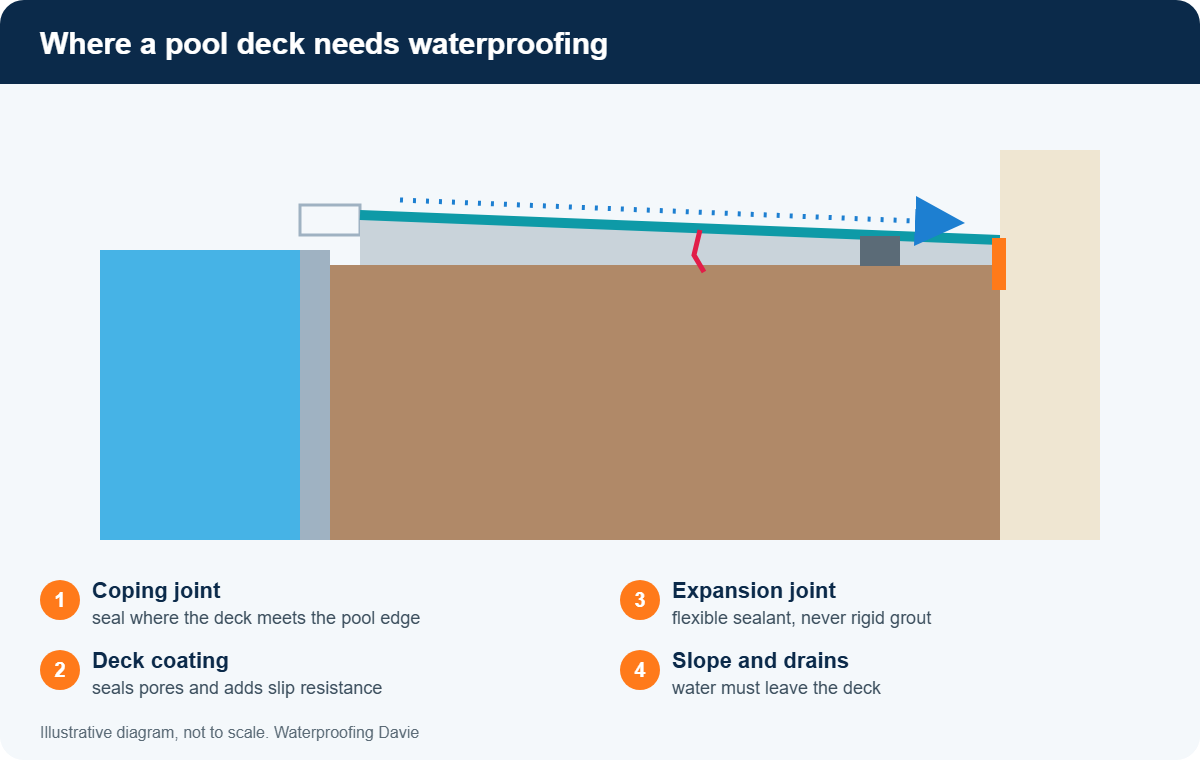
Pool Deck Finishes and Coatings Compared
Contractors use several systems. This table shows how they generally differ.
| System | What it is | Best for | Watch out for |
|---|---|---|---|
| Acrylic textured coating | Water-based coating with a sand-like finish | Most concrete decks in good condition | Needs a sound surface and periodic recoating |
| Cementitious overlay | Thin cement-based layer that can be textured or colored | Resurfacing worn or stained concrete | Can crack if the slab moves |
| Polyurethane or polyaspartic | Tough, chemical-resistant liquid membrane | Heavy use, fast cure and strong stain resistance | Needs careful prep and professional application |
| Epoxy system | Hard, durable chemical-resistant coating | Garages and covered areas | Can be slippery and degrade in UV if not UV-stable |
| Penetrating sealer | Clear product that soaks into concrete | Unpainted decks where the look should stay | Does not bridge cracks |
| Paver and stone sealer | Film or penetrating sealer for pavers and travertine | Pavers, travertine and stamped concrete | Does not fix a failing base or settled pavers |
Ask for the product data sheet, an actual sample finish and details on slip resistance and heat.
Waterproofing by Area
Each outdoor surface has different needs. Choose the closest.
The most common deck type.
- Clean, repair cracks and etch or prepare the surface
- Seal expansion joints and the joint at the coping
- Apply a coating or sealer with a slip-resistant finish
Check slope so water runs away from the pool and house.
Paver and stone decks drain through joints.
- Clean and remove old sealer, algae and stains
- Re-level settled areas and refill joints
- Apply a suitable sealer for the material
Sealers protect surfaces but cannot repair a failed base.
Lanais combine concrete floors, screens and house walls.
- Seal slab cracks and the joint at the house wall
- Coat the floor with a durable, slip-resistant finish
- Check screen enclosure bases and drainage
Moisture at the house wall should be traced to its source.
The edge of the pool is a high-stress area.
- Inspect coping stones, tile and grout for loose or cracked areas
- Replace failed sealant between coping and deck
- Coordinate with a pool professional for any work at the shell
Leaks at the waterline or shell are a pool repair, not a deck repair.
Large slabs and counters often sit beside the pool.
- Seal joints and penetrations
- Protect surfaces from grease, stains and splash
- Make sure water drains away from walls and appliances
A durable coating helps keep the area clean.
How Pool Deck Waterproofing Works: Four Steps
A thorough job follows this order.
1
Inspect and test
Check cracks, joints, slope, drainage and the condition of the surface and coping.
2
Clean and repair
Remove old sealers, algae and loose material, repair cracks and spalls and re-seal joints.
3
Prime and coat
Apply primer where needed, then the coating or sealer in the specified coats with an anti-slip finish.
4
Cure and walk through
Keep the deck dry and free of traffic while it cures, then inspect and receive photos and warranty terms.
Common Pool Deck Problems and What Causes Them
| What you see | What it usually means | Typical response |
|---|---|---|
| Hairline cracks | Concrete shrinkage and temperature movement | Seal and coat to keep water out |
| Wide or stepped cracks | Base washout, settlement or root pressure | Evaluate the cause before cosmetic repair |
| Failed joint sealant | Sun, chemicals and movement wore it out | Remove old sealant and install flexible sealant |
| Peeling or flaking coating | Poor prep, moisture or age | Strip, repair and recoat |
| White powder or rust stains | Salts and iron carried by moisture | Clean, seal and fix the water source |
| Standing water | Low spots or blocked drains | Regrade, add drainage or use a coating that tolerates water |
| Algae and slick spots | Constant dampness and shade | Clean, improve drainage and apply slip-resistant finish |
Pool Deck Cracks vs. Pool Leaks
People often mix these up. The solutions come from different trades.
| Deck crack or joint problem | Pool leak | |
|---|---|---|
| Where it shows | On the deck surface, in joints and around coping | Falling water level, wet soil near the pool, high water bills |
| Cause | Slab movement, wear and failed sealant | Shell cracks, plumbing, skimmers or fittings |
| Who fixes it | Waterproofing contractor | Pool leak detection and repair professional |
| What it risks | Seepage, staining and washed-out soil | Water loss, equipment strain and soil damage |
| Best step | Seal joints and coat the deck | Test the pool for leaks before deck work |
If you are not sure, tell us what you are seeing and we will help sort out who to call.
What Affects the Cost of Pool Deck Waterproofing
We do not quote prices by phone because every deck differs. These are the main factors.
| Factor | Why it matters | Effect on cost |
|---|---|---|
| Deck size and shape | More surface and many corners take more time and material | Higher with size |
| Condition and repairs | Cracks, spalls and old coatings add prep | Higher |
| System chosen | Different products and thicknesses cost differently | Varies |
| Joints and details | Long joints, coping and steps add labor | Higher |
| Access and downtime | Furniture, plants and pool schedules affect the work | Can add time |
| Warranty requirements | Longer warranties often require specified prep and thickness | Varies |
Mistakes That Shorten the Life of a Pool Deck Coating
- Coating over cracks and failed joints. Water gets under the coating and lifts it.
- Skipping surface prep. Old sealers, algae and oils stop coatings from bonding.
- Choosing a slick finish. Wet, barefoot traffic needs real texture.
- Using dark colors without testing. Surface temperature in sun can be uncomfortable.
- Using rigid grout in expansion joints. It cracks as the slab moves.
- Ignoring slope and drainage. Standing water shortens the life of every coating.
- Choosing only on price. A thin, quick coat fails early.
Why Pool Decks Take a Beating in Davie
Local conditions make pool decks one of the hardest-working surfaces on a property.
Sun and heat
Year-round sun bakes sealants and coatings and fades colors, and a dark deck can be uncomfortably hot.
Heavy rain
Summer downpours soak slabs and wash soil from under decks, which leads to settlement and cracks.
Chemicals and salt
Chlorine, salt systems and cleaning products wear down surfaces and sealants.
Irrigation and landscaping
Sprinklers that hit the deck keep it wet, and tree roots can lift slabs.
HOA and community rules
Many communities regulate colors, finishes and work schedules. Ask your association what applies. If the same surfaces include driveways and walkways, see our page on concrete sealing and crack repair.
A Pool Deck Care Calendar for Davie
| When | What to do | Why it helps |
|---|---|---|
| Late winter to early spring (Feb – Apr) | Inspect joints, cracks and coatings, and schedule repairs. | Work is done before the rainy season and heavy pool use. |
| Rainy season (May – Oct) | Watch for standing water and new cracks, and keep drains and skimmers clear. | Early notice keeps repairs small. |
| Before a named storm | Clear loose items from the deck and photograph its condition. | Reduces debris and documents condition. |
| After a major storm | Check for debris, new cracks and washed-out edges. | Quick repair prevents further damage. |
| Drier months (Nov – Jan) | Schedule coatings, sealers and joint work. | Dry weather gives the best cure. |
Pool Deck Waterproofing for Different Property Types
| Property type | Common situation | What owners usually need |
|---|---|---|
| Single-family homes | Cracked deck, failed joints and a faded coating | Crack and joint sealing, plus a slip-resistant coating |
| Townhomes and HOA communities | Shared pools and uniform finishes | Approved colors, phased work and documentation for the board |
| Condominiums | Amenity decks and rooftop pool decks | Coordination with pool operations and waterproofing of deck structures |
| Commercial and hospitality | High traffic and rules for public pools | Durable systems, scheduled outages and compliance paperwork |
| Rental properties | Turnover and safety concerns | Quick repairs, slip-resistant surfaces and written scope |
What a Good Pool Deck Estimate Should Include
- Inspection findings: photos of cracks, joints, slope and drainage.
- Repairs before coating: cracks, spalls, settled areas and joints.
- Surface preparation: cleaning, stripping and profile methods.
- The exact system: product names, number of coats, finish and a sample.
- Color and heat: color options and surface temperature guidance.
- Slip resistance: how the finish achieves traction when wet.
- Coordination: how the work interacts with the pool, equipment and landscaping.
- Schedule and weather plan: expected duration and cure time.
- Warranty: what is covered, for how long and what voids it.
Caring for a Coated Pool Deck
- Rinse the deck regularly and clean with products recommended by the coating maker.
- Avoid harsh acids and high-pressure washing unless the contractor approves them.
- Keep drains, skimmers and gutters clear so water does not stand on the deck.
- Point sprinklers away from the deck and walls.
- Re-check joints and cracks each spring and after storms, and fix small gaps early.
- Keep product names, colors and warranty documents together so touch-ups match.
Questions to Ask Before You Approve Pool Deck Work
Use these to compare estimates on equal terms.
| Question | Why it matters | What a good answer sounds like |
|---|---|---|
| How will you repair the cracks? | Coatings do not bridge moving cracks | Cracks are routed, filled or stitched and then sealed before coating |
| What happens at the expansion joints? | Rigid materials fail at joints | Old sealant removed and flexible sealant installed |
| How is the finish made slip-resistant? | Wet, barefoot traffic needs traction | A named aggregate or texture and a sample to test |
| What color and surface temperature should I expect? | Dark decks get very hot | Light or cool-deck colors with a daylight sample |
| How long before the deck can be used? | Cure time affects the pool schedule | A written cure time that accounts for humidity and rain |
| How will you protect the pool and equipment? | Debris and overspray cause problems | Covers, masking and cleanup described in the scope |
| What does the warranty cover? | Warranties differ widely | Written terms for coating, joints and labor, with exclusions listed |
Safety, Slip Resistance and Heat Around the Pool
A pool deck is not just a waterproofing project. It is a place where people walk barefoot on wet surfaces, so traction is part of the job.
Traction when wet
Ask to test a sample finish with wet bare feet. A finish that feels fine dry can be slick when wet, and algae or oils make it worse.
Surface temperature
Lighter colors reflect more sun and stay cooler underfoot. Always check a sample in full afternoon sun before choosing a color.
Drainage and standing water
Water that stays on the deck shortens the life of every coating and creates slippery spots. Slope and drains should move water away from the pool and the house. For related moisture control around the building, see our page on drainage and water management.
Edges, steps and transitions
Steps, pool edges and door thresholds are where trips and falls happen. A good scope describes how these areas are finished and marked.
Typical Pool Deck Project Timeline
Every deck differs, but most projects follow this general pattern.
| Stage | What happens | General notes |
|---|---|---|
| Estimate and inspection | Walk the deck, document cracks and joints and discuss options | Photos and notes become part of the written scope |
| Preparation | Clean, strip old coatings and repair cracks and joints | Often the longest and most important stage |
| Coating or sealing | Apply primer and coats in the specified order | Weather and humidity affect timing |
| Cure | Keep foot traffic, furniture and water off the surface | Follow the maker’s cure instructions |
| Final walkthrough | Inspect the finish and review care and warranty documents | Keep paperwork for future touch-ups |
When Pool Deck Work Needs a Different Specialist
Waterproofing a deck is only part of pool care. Some problems need other trades, and recognizing them early saves money.
Pool shell or plumbing leaks need a pool leak detection professional. Settled or lifted slabs may need leveling or replacement by a concrete contractor. Electrical, bonding and barrier requirements belong to licensed trades and local code. If you are not sure whom to call, describe what you see and we will help point you to the right independent professional.
Who Does the Work
Waterproofing Davie is a local referral service. We do not perform the work ourselves. Independent contractors do the work and provide their own written estimate, warranty terms, license and insurance details. Before you approve work, ask the contractor to confirm their Florida license and insurance in writing and verify both with the State of Florida. Pool deck coatings should be applied by crews trained in slip-resistant finishes, and work near the pool edge should be coordinated with your pool professional.
Frequently Asked Questions About Pool Deck Waterproofing in Davie
Related Waterproofing Services
Waterproof painting and sealing
Protective coatings for walls, trim and outdoor surfaces.
Get a Pool Deck Waterproofing Estimate in Davie
Tell us about the deck surface, the cracks or stains you see and whether it slopes toward the pool or house. Photos help. You will get a plain-language explanation and a written estimate before any work starts.