
Home › Services › Window and Door Caulking
Window and Door Caulking in Davie, FL
Most window and door leaks do not come through the glass. They come through the joint around it. Replacing worn sealant is one of the lowest-cost ways to keep wind-driven rain out of your walls.
Local referral to independent contractors · Written estimate before work starts · Emergency leaks welcome

Windows and Doors at a Glance
~60 in.
of rain Davie openings face in a typical year
Every joint
is a place water can enter where materials meet
Jun 1 – Nov 30
storm season, when wind pushes rain sideways
Dry joint
required for sealant to bond properly
Quick Answer: Why Recaulk Windows and Doors?
Sealant is the flexible waterproof gasket between a window or door frame and the wall around it. In Davie’s sun and rain it dries, shrinks and cracks, and once it fails, water can run behind the frame, into the wall and down to the interior. Recaulking means removing the failed bead, cleaning the joint, and applying a suitable exterior sealant so the joint is flexible and watertight again. Call (754) 258-3576 or text photos for a written estimate from an independent local contractor.
Openings are one of several entry points for water. For roofs, walls, slabs and drainage, see the overall waterproofing process we follow in Davie.
Signs Your Windows and Doors Need Attention
These signs are worth checking after any heavy rain.
Cracked or gapped sealant
Beads that are split, shrunken, hard or pulling away from the frame or wall no longer keep water out.
Stains and peeling paint
Water marks below corners, bubbling paint on the trim or wall and damp drywall around the frame point to a leak.
Drafts and noise
Air whistling through gaps or a noticeably cooler or warmer spot can show where sealant has failed.
Water at the sill or threshold
Pooled water on the sill, damp carpet or floor near a slider or door often comes from the joint above or beside it.
Where Window and Door Leaks Start
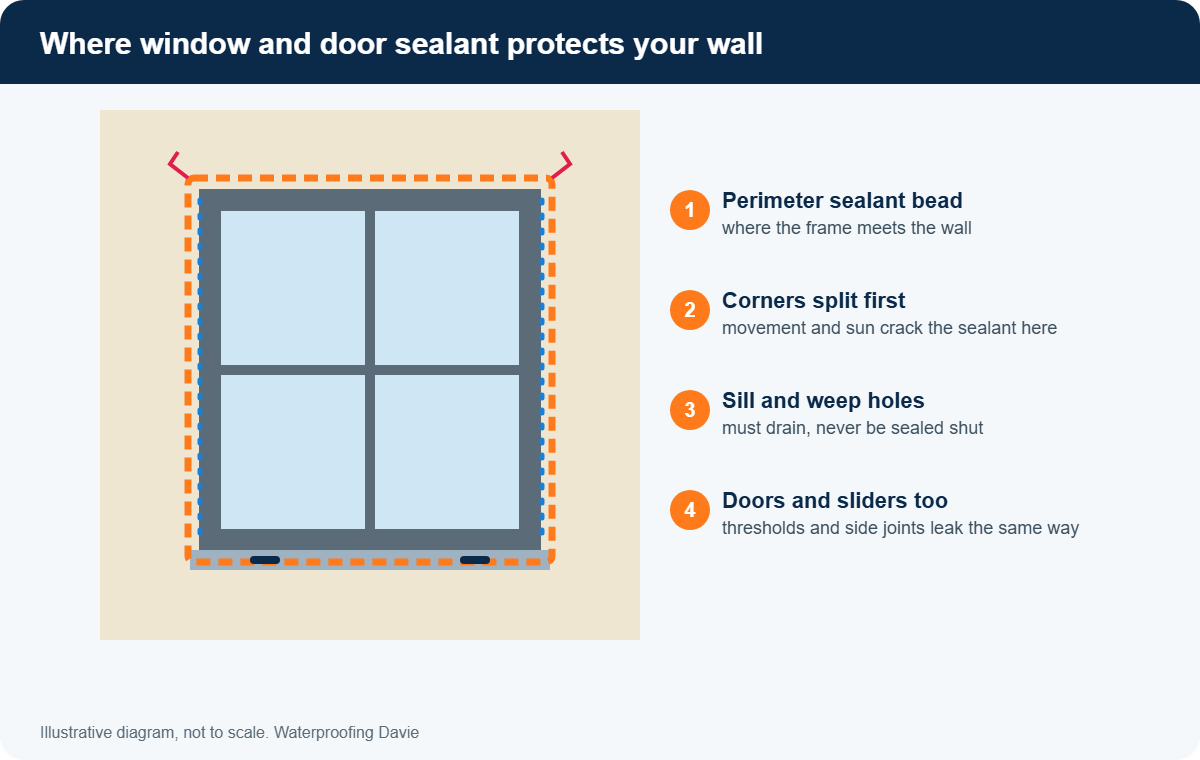
Wind-driven rain is the real test. In a storm, rain hits the wall from the side and is pushed into the smallest gap. The weak point is almost always a joint: the bead around the frame, the corner where two joints meet, the meeting of a sill and the wall, or the bottom corner of a slider where the track meets the frame.
Corners fail first, because joints move most there and because stucco cracks tend to start at window corners. Once the corner opens, water follows the frame down to the sill and either runs inside or soaks into the wall below.
Because windows sit in walls, it also helps to look at the wall around them. Cracks that run from corners need stucco repair as well as new sealant. See our guide to stucco cracks around windows and walls for the full picture.
What Gets Caulked: Openings and Joints
Choose the opening closest to yours.
Windows have several joints that need to be sound.
- The perimeter joint between the frame and the wall
- Corners and mullion joints
- The sill and any sill pan or flashing visible at the base
- Glazing joints between glass and frame where applicable
Weep holes at the bottom of the frame must stay clear so water can drain.
Sliders are large openings with heavy movement.
- Perimeter joints at head, jambs and threshold
- Track corners and the joint where the track meets the frame
- Weep holes and drain channels in the track
Water that pools in a slider track and leaks inside often points to a blocked drain or a failed corner seal.
Door frames and thresholds take direct weather and daily use.
- Frame and jamb joints and the joint at the threshold
- Door sweep and weatherstripping
- Garage door perimeters and side jambs
Thresholds and weatherstripping are often replaced together with sealant.
Commercial glass and aluminum systems have many long joints.
- Glass-to-frame and frame-to-wall joints
- Expansion and control joints in the façade
- Door and curtain wall transitions
Plan work to minimize disruption to business hours.
Sealants Compared
Contractors choose among several products. This table shows how they generally differ.
| Sealant type | Strengths | Limits | Often used for |
|---|---|---|---|
| Silicone | Very flexible and highly UV stable, with long service life | Most types cannot be painted and can stain porous surfaces if not chosen carefully | Glass, metal, and joints that will not be painted |
| Polyurethane | Strong bond, paintable and durable | Can degrade in strong UV if left uncoated, depending on the product | Masonry and stucco joints and painted surfaces |
| Hybrid or MS polymer | Good adhesion to many surfaces, paintable and low odor | Performance varies by product | General purpose exterior joints |
| Acrylic latex with silicone | Easy to work with and paintable | Shorter life and less movement capability | Interior or low-movement joints |
| Backer rod and joint filler | Controls joint depth and supports the bead | Not a sealant by itself | Wider joints |
Ask the contractor to name the product and show the data sheet, including its movement rating and whether it is paintable.
How Window and Door Caulking Works: Four Steps
The result depends on preparation more than the product. Our contractors follow steps like these.
1
Inspect and test
Check each opening, note failed joints, stains and cracks, and test for water entry where needed.
2
Remove and clean
Cut out the old sealant, clean the joint, remove dust and moisture and prime if the product requires it.
3
Install backer and sealant
Insert backer rod where the joint is deep, apply sealant in a continuous bead and tool it into firm contact with both sides.
4
Cure, check and document
Let the sealant cure as specified, check weep holes and finish, and provide photos and written warranty terms.
Recaulk, Reseal Around Repair or Replace the Window?
| Option | Best when | Limits | Think about |
|---|---|---|---|
| Recaulk perimeter | Frame is sound and the sealant is aging or cracked | Will not fix a failed window or glass unit | Do all openings on an elevation at once |
| Recaulk plus stucco repair | Cracks run from corners or the wall around the frame is damaged | Needs matching texture and paint | Coordinate sealant and wall repair |
| Glass or glazing repair | Fogged panes or cracked glass | Not an exterior sealant job | Ask a glazier or window specialist |
| Window or door replacement | Frame is damaged, leaking at the structure or no longer operates | Highest cost, permits and product approvals | Get several written estimates and confirm installation details |
Joint Details That Make Caulking Last
Caulk that looks fine on day one can still fail if the details are wrong. A good contractor pays attention to the following.
- Joint size: sealant should be applied at a proper width and depth. Many sealants perform best when the depth is about half the width, so wide, deep joints need backer rod.
- Adhesion: the surfaces must be clean, dry and sound. Dust, old sealant and moisture stop adhesion.
- Primer where required: some surfaces, such as porous masonry and certain metals, need primer for a lasting bond.
- Three-sided bonding avoided: sealant should bond to two sides, not three, so it can stretch without tearing.
- Tooling: pressing the bead into the joint ensures contact and a smooth surface that sheds water.
- Weep holes and drainage paths: these must stay open.
- Compatibility: the sealant must suit the frame material, wall finish and any paint.
Ask the contractor how they handle each point, and look at the joints from different angles after the work is done.
What Affects the Cost of Window and Door Caulking
Every home is different, so we do not quote prices by phone. These are the main drivers.
| Factor | Why it matters | Effect on cost |
|---|---|---|
| Number and size of openings | More and larger openings mean more linear feet of joints | Higher with count and size |
| Height and access | Second-story windows need ladders, lifts or scaffolding | Higher |
| Condition of old sealant | Stubborn, hardened or multiple layers take longer to remove | Higher |
| Wall and frame repairs | Cracks, rot or damaged trim add scope | Higher |
| Sealant type | Premium products cost more but often last longer | Varies |
| Weather and scheduling | Dry conditions are needed, so jobs may be delayed | Can add time |
Mistakes That Make Window Leaks Worse
- Caulking over old, dirty sealant. It will not bond for long.
- Sealing weep holes. This traps water inside the frame.
- Using interior-grade caulk outside. It cracks and shrinks quickly in sun and rain.
- Filling deep joints without backer rod. The bead tears as the joint moves.
- Caulking in the rain or over damp surfaces. The sealant does not cure or bond.
- Ignoring the wall. Cracks and damaged stucco around frames keep leaking even with new caulk.
- Choosing only on price. A cheap, quick bead without prep fails early.
Interior Clues and Exterior Clues: How to Tell Where Water Is Coming From
Leaks around openings can look like roof leaks, plumbing leaks or condensation. This comparison helps you describe the problem to a contractor.
| What you notice | Likely cause | What to do |
|---|---|---|
| Stain or damp trim at the top corners of a window | Failed head or corner sealant, or a roof or wall leak above | Check the sealant and the wall and roof above the window |
| Water on the sill or floor beneath a slider after rain | Blocked weep holes, track drains or failed corner seals | Clean weep holes and have the joints inspected |
| Dampness or mold in a bottom corner of a wall | Water running down the frame and into the wall | Have the opening and wall inspected for moisture |
| Condensation on the glass or between panes | Humidity, or a failed glass unit seal | See a glazing specialist if between panes |
| Stains that appear on dry days | Plumbing or air conditioning leak | Have a plumber or HVAC technician check |
| Leak only during storms with strong wind | Wind-driven rain through small gaps in joints | Seal all joints on the windward side |
A Window and Door Care Calendar for Davie
| When | What to do | Why it helps |
|---|---|---|
| Late winter to early spring (Feb – Apr) | Inspect all window and door sealants and clear weep holes. | Problems are fixed before the rainy season. |
| Rainy season (May – Oct) | Check trim and ceilings after heavy rain, and keep sliders’ tracks clear. | Early notice limits damage. |
| Before a named storm | Photograph openings, and clear weep holes and tracks. | Documents the condition and helps drainage. |
| After a major storm | Check for new gaps, stains and damp walls around openings. | Fast repair prevents interior damage. |
| Drier months (Nov – Jan) | Schedule recaulking and wall repairs. | Sealant cures best in dry weather. |
Why Window and Door Leaks Are Common in Davie
Several local conditions explain why openings leak.
Wind-driven rain
Storm winds push water sideways into joints and gaps that stay dry in ordinary rain.
Sun and heat
Ultraviolet light and daily heat cycles dry out and crack sealants, especially on west and south walls.
Impact windows and heavy frames
Many homes have impact windows. They are very strong, but the perimeter sealant is what keeps water out of the wall around them.
Sliders and large openings
Large glass doors move more with temperature and wind, so the joints around them work harder.
HOA rules and approvals
Some communities require approval of sealant color and exterior work. Ask your association what applies. If water is also coming through the ceiling during storms, see our page on emergency leak repair for first steps.
What a Good Caulking Estimate Should Include
- Scope: which openings and which joints will be sealed.
- Removal and prep: how old sealant will be removed and joints cleaned.
- Product: sealant brand, type, color and data sheet.
- Backer rod and primer: where they will be used.
- Weep hole care: confirmation that drains will be cleaned and left open.
- Schedule and weather plan: expected duration and what happens in rain.
- Protection and cleanup: how floors, plants and surfaces will be protected.
- Warranty: what is covered, for how long and what voids it.
Window and Door Caulking for Different Property Types
| Property type | Common situation | What owners usually need |
|---|---|---|
| Single-family homes | Aging perimeter sealant, sliders that leak in storms and stains below corners | Full perimeter recaulking, weep hole cleaning and spot stucco repair at corners |
| Townhomes and HOA communities | Uniform exteriors and approval rules for colors and products | Approved sealant colors, phased work across buildings and documentation for the board |
| Condominiums | Many openings, balcony doors and tall walls | Access planning, balcony door sealing and records for the association |
| Commercial and retail | Storefront glass, aluminum frames and large façades | Joint inspection, sealant replacement and work scheduled outside business hours |
| Rental properties | Repeated leak complaints from tenants | Quick fixes, written scope and photos for owners and insurers |
How to Read a Caulking Warranty
Warranties on sealant work differ widely. Ask the contractor to explain each point and put the answers in writing.
| Question | Why it matters |
|---|---|
| Does the warranty cover labor, material or both? | Some cover only the product and not the work to redo it. |
| How long does it last? | Terms vary, and coverage may be shorter for exposed or high-movement joints. |
| What voids it? | Pressure washing joints, painting over unpainted sealant or alterations to the frame may void coverage. |
| Are leaks inside covered or only the sealant? | Most warranties cover the sealant work, not damage to interiors. |
| What is the process for a claim? | Knowing whom to call, and what documents to provide, saves time. |
After the Work: What to Expect and How to Check
Sealant takes time to cure and needs a little care at first. Use the checklist below.
- Avoid touching or washing the new sealant until the contractor says it has cured, which can take from hours to days depending on the product.
- Check that the bead is continuous, smooth and fully bonded to both surfaces, with no gaps, pinholes or air bubbles.
- Confirm that weep holes and track drains are clear and that the sealant did not cover them.
- Look at the joints after the first heavy rain, and note any stains or damp spots.
- If you plan to paint, confirm that the sealant is paintable and wait the recommended time before painting.
- Keep the product name, color and warranty paperwork so a future touch-up matches.
- Re-check every spring, and after major storms, since small gaps are easier to fix than failed joints.
Who Does the Work
Waterproofing Davie is a local referral service. We do not perform the work ourselves. Independent contractors do the work and provide their own written estimate, warranty terms, license and insurance details. Before you approve work, ask the contractor to confirm their Florida license and insurance in writing and verify both with the State of Florida.
Frequently Asked Questions About Window and Door Caulking in Davie
Related Waterproofing Services
Get a Window and Door Caulking Estimate in Davie
Tell us which windows or doors leak, when it happens and how long you have noticed it. Photos help. You will get a plain-language explanation and a written estimate before any work starts.