
Home › Services › Roof Leak Repair
Roof Leak Repair in Davie, FL
A stain on your ceiling is only where the water ended up. Good roof leak repair finds where it started, fixes that point and the weak spots around it, and checks that water can drain away.
Local referral to independent contractors · Written estimate before work starts · Emergency leaks welcome

Davie Roofs at a Glance
~60 in.
of rain in a typical Broward County year
May – Oct
rainy season, when most leaks first show
Jun 1 – Nov 30
Atlantic hurricane season
3 steps
trace, repair, check drainage
Quick Answer: What Should I Do About a Roof Leak in Davie?
Call as soon as you see a stain, drip or damp ceiling. Water inside a roof spreads quickly through insulation and drywall and can lead to mold within a day or two. The fix has three parts: trace the real entry point, repair it and the weak spots around it, then check that gutters, drains and slopes carry water away. Call (754) 258-3576 or text photos and we will connect you with an independent local roofing contractor for a written estimate.
If the water may be coming from walls, windows or a slab and not only the roof, start with the Davie waterproofing referral service, which looks at the whole building.
Signs You Have a Roof Leak
Not every roof leak drips. Many show up slowly, so these are worth checking after any heavy rain.
Ceiling stains
Yellow or brown rings that spread after rain. A ring with a darker edge usually means the area has been wet more than once.
Bubbling or peeling paint
Paint that blisters on a ceiling or at the top of a wall is often trapping moisture behind it.
Musty smell or dark spots
A damp odor in a closet or upstairs room, or mold-like spots on a ceiling, points to moisture that has been present for a while.
Outside clues
Missing or slipped tiles, curled shingles, cracked sealant around vents, and granules in gutters all suggest a roof is losing its seal.
Why Roof Leaks Are Hard to Find
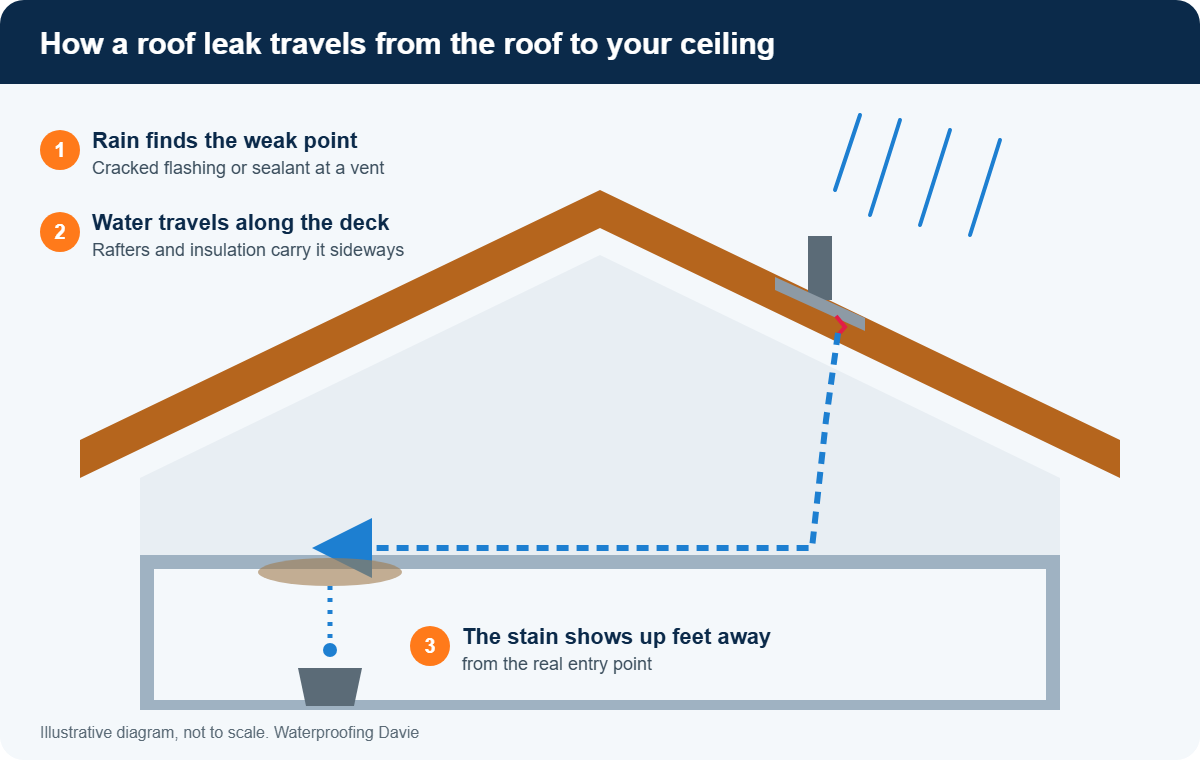
Water rarely drips straight down from the hole. It runs along the roof deck, a rafter or the top of the insulation until it finds a gap in the ceiling, and that can be several feet from where it first got in. That is why guessing and patching under the stain so often fails.
A proper leak check follows the water path both ways. Start at the stain, trace upstream through the attic, then match what you find to what is on the roof surface: a vent boot, a chimney corner, a valley, a cracked tile or a seam. Most leaks come from a penetration, a joint or a transition, not from open field shingles or tile.
Wind-driven rain makes it harder still. In a storm, water is pushed sideways and upward under flashing that stays dry in ordinary rain, so a leak can appear only during the strongest weather.
Where Roof Leaks Start in Davie, by Roof Type
The common leak points depend on what is on your roof. Choose your roof type to see what to check.
Tile sheds water, but the waterproofing layer is the underlayment beneath it, and that wears out sooner than the tile itself. Tile leaks often come from:
- Aged or torn underlayment under otherwise good-looking tile
- Cracked, slipped or broken tiles after storms or foot traffic
- Failed mortar or foam at ridges, hips and rake edges
- Worn flashing at walls, valleys, chimneys and skylights
Replacing a few tiles stops a local leak, but if the underlayment is at the end of its life, leaks keep returning. A good inspection tells you which case you have.
Asphalt shingles lose granules and flexibility in strong sun and heat. Common leak points include:
- Lifted, curled or missing shingles, especially on the windward side
- Nail pops that push through the shingle surface
- Dried-out sealant around vent boots and pipes
- Open or rusted valley metal and step flashing
Spot repairs work on a roof that is otherwise sound. Widespread curling or granule loss usually points to replacement planning, not repeated patching.
Metal sheds water well, but leaks occur at fasteners, seams and details:
- Loose or backed-out screws and worn washers
- Failed sealant at seams, laps and end caps
- Rust at cut edges, fasteners and where metal meets other materials
- Flashing at walls, skylights and curbs
Tightening or replacing fasteners and resealing seams stops many leaks, and coating can extend the life of an aging metal roof.
Flat roofs are the most leak-prone because water does not run off quickly. Typical causes include:
- Ponding water that sits for days and wears the surface
- Open seams, blistering and cracked membranes
- Failed flashing at parapets, curbs and drains
- Clogged drains and scuppers
Many flat roof leaks can be repaired locally, and a coating can seal and protect the whole surface. See our page on flat roof coating in Davie for options.
Common Roof Leak Sources and Typical Fixes
This table shows how contractors usually link a symptom to a cause and a repair. Your actual repair depends on the inspection.
| Leak source | What you may see | Typical repair | How urgent |
|---|---|---|---|
| Vent pipe boots and plumbing stacks | Stain near a bathroom or kitchen wall; cracked rubber collar | Replace boot or collar, reseal flashing | Soon |
| Chimney, wall and skylight flashing | Stain along a wall line or around a skylight | Re-flash, replace sealant, add counterflashing | Soon |
| Roof valleys | Stain under a valley after heavy rain | Clean, repair or replace valley metal and underlayment | Soon |
| Cracked or slipped tiles | Visible damage, drip after wind-driven rain | Replace tiles, reset and reseal | Soon |
| Worn underlayment (tile roofs) | Multiple leaks that keep returning | Underlayment replacement or re-roof planning | Plan ahead |
| Flat roof seams and ponding | Water standing, blisters, stains below flat areas | Seam repair, drain clearing, coating | Soon |
| Fasteners on metal roofs | Small drips near screw lines or rust streaks | Replace fasteners and washers, reseal | Soon |
| Clogged drains and gutters | Overflow at edges, water backing under roofing | Clear and repair drainage, adjust slope | Soon |
| Storm damage | Missing roofing, exposed deck, active leak | Temporary protection first, then permanent repair | Emergency |
How a Roof Leak Repair Works: Four Steps
Contractors we refer follow a similar sequence, so you can compare estimates like for like. See our step-by-step waterproofing process for the full approach.
1
Inspect inside and out
Look at the ceiling, attic or access space, and the roof surface. Photos and moisture readings document what is wet and how far it has spread.
2
Trace the water path
Follow the water from the stain back to the entry point, checking penetrations, joints, valleys and transitions near it.
3
Repair the entry and weak spots
Fix the source and nearby weak areas so the repair lasts, using materials matched to your roof type and the manufacturer’s requirements.
4
Test and check drainage
Confirm the repair holds and that gutters, drains and slopes carry water away. You get a written summary of what was found and done.
Patch, Repair, Coat or Replace: Which Is Right?
The right answer depends on the age of the roof, how widespread the damage is and how long you plan to keep the property.
| Option | Best when | Limits | Think about |
|---|---|---|---|
| Spot repair | One or two clear entry points and a roof in otherwise good shape | Does not help if materials elsewhere are failing | Ask the contractor to inspect the rest of the roof too |
| Section repair | Damage across one slope, valley or flat section | New materials may not match old ones | Matching color and HOA rules |
| Coating or restoration | Sound roof with a worn surface, especially flat and metal roofs | Not a fix for rotted deck or saturated insulation | Surface prep and warranty terms |
| Partial or full replacement | Roof at end of life, repeated leaks, widespread deterioration | Higher cost and permits | Compare multiple written estimates and timing before hurricane season |
What Affects the Cost of a Roof Leak Repair
Every roof is different, so we do not quote prices by phone. These are the factors that move an estimate up or down.
| Factor | Why it matters | Effect on cost |
|---|---|---|
| Roof type and material | Tile, shingle, metal and flat systems use different materials and methods | Varies by system |
| Number of leak points | Several problem areas take more time than one | Higher with more points |
| Access and height | Steep pitch, tall buildings and limited access need more safety work | Higher |
| Extent of hidden damage | Wet insulation, soft deck or rot adds repair scope | Higher |
| Roof age and condition | Old materials are harder to match and may not hold a repair | Varies |
| Permits and inspections | Some work requires a permit in Broward County | Adds some cost and time |
| Timing and weather | Emergency and storm-season work is in higher demand | Can be higher |
Ask each contractor for an itemized written estimate that names the materials, the scope and what is not included, so you can compare options fairly.
DIY or Professional? What Is Safe to Do Yourself
Safe for most owners
- Take dated photos of stains and any visible damage
- Move belongings and place buckets or plastic sheeting
- Clear gutters and drains you can reach from the ground
- Check ceilings after each storm and note new stains
- Keep receipts for emergency measures
Leave to a professional
- Walking on the roof, especially when wet or steep
- Cutting into ceilings or removing roofing
- Using roof cement and sealants over wet or failing areas
- Anything involving power near wet fixtures
- Work on tile, metal or flat roofs without the right training
Mistakes That Make Roof Leaks Worse
- Patching under the stain. The stain is not the source, and covering it hides the problem.
- Coating over wet or dirty roofing. Sealants need clean, dry surfaces to bond.
- Using the wrong sealant. Some products crack in Florida sun or do not stick to certain materials.
- Waiting for the next storm. Small leaks soak insulation and wood, which turns a simple repair into a larger one.
- Pressure washing a worn roof. It can force water under tiles and shingles.
- Choosing on price alone. A low estimate that skips the inspection can cost more when the leak returns.
What to Do Right Now If Your Roof Is Leaking
If water is coming in, these steps protect your home while you arrange repairs.
- Keep everyone away from the wet area, and turn off power to any wet fixture or outlet if you can do so safely.
- Move furniture, electronics and valuables, and cover what you cannot move with plastic sheeting.
- Place a bucket under the drip. If a ceiling is bulging with water, a small hole made carefully can release it and avoid a collapse, but only if it is safe to stand below.
- Take photos and short videos of the damage before you clean up.
- Do not go onto a wet roof. Call us at (754) 258-3576 and we will connect you with a contractor. For more detail, see our emergency leak repair page.
Why Roof Leaks Are Common in Davie
Davie sits in Broward County, where heavy rain, strong sun and tropical storms all work on a roof at once. The conditions below explain why leaks are so common here and why timing matters.
Heavy rain and wind-driven storms
Rainy-season downpours can drop an inch or more in an hour. Storm winds push that water sideways and uphill under flashing and tile, so leaks can appear only in the worst weather.
Intense sun and heat
Ultraviolet light and heat dry out sealants, shingles and membranes. Rubber vent boots, caulk and flat roof surfaces crack and shrink over time, which opens small gaps.
Hurricane season
From June 1 to November 30, storms can loosen tiles, lift edges and damage flashing. Roofing that was marginal before a storm often leaks after it, so a spring check is worth the time.
Older homes and mixed roof types
Davie has a mix of older block homes, newer tile-roof communities, rural properties with metal roofs and commercial flat roofs. Each has its own weak points, which is why we match the contractor to the roof.
HOA and community rules
Many communities regulate roofing materials and colors. Ask your association what approvals you need before work starts, and tell the contractor early so the estimate reflects it. Wall and window leaks can mimic roof leaks, so if the source is unclear, see our guide to stucco cracks and wall leaks. We serve homes across Davie and nearby cities listed on our service areas page.
A Roof Care Calendar for Davie Owners
Timing matters in South Florida. This calendar shows when each task makes the most difference.
| When | What to do | Why it helps |
|---|---|---|
| Late winter to early spring (Feb – Apr) | Get the roof inspected. Check flashing, sealants, tiles or shingles and drains, and trim branches that touch the roof. | Small defects are cheaper to fix before the rainy season, and contractors are less busy. |
| Rainy season (May – Oct) | Check ceilings after heavy rain, keep gutters and drains clear and photograph any new stains with the date. | Early notice keeps a small leak small and gives you a record for insurance. |
| Before a named storm | Clear loose items from the yard and roof edges, check drains and take dated photos of the roof and ceilings. | Photos show the condition of the property before the storm. |
| After a major storm | Look for missing tiles or shingles, exposed deck and new interior stains, then call quickly for temporary protection. | Temporary protection limits further damage while permanent repairs are scheduled. |
| Drier months (Nov – Jan) | Schedule permanent repairs, resealing and coatings that need dry surfaces. | Sealants and coatings bond best in dry weather. |
What a Good Roof Leak Inspection Covers
A thorough inspection takes more than a quick look from a ladder. When you compare estimates, ask whether each contractor will cover these points.
- Interior check: ceilings, walls and the attic or access space, using a moisture meter where possible to see how far the dampness has spread.
- Roof surface: tiles, shingles, metal panels or flat roofing, checked for damage, wear and loose or missing pieces.
- Penetrations and flashing: vents, pipes, chimneys, skylights, walls and valleys, where most leaks start.
- Drainage: gutters, scuppers, drains and the roof slope, including any ponding water.
- Age and condition: an honest view of how much life the roofing has left, so you can decide between repair, coating and replacement.
- Written findings: photos, a plain-language explanation of the cause and an itemized estimate.
After the Repair: Keeping Your Roof Dry
A repair works best when it is followed by simple habits. Keep drains and gutters clear, trim branches away from the roof, and check your ceilings after the first few heavy rains following a repair. Keep your estimate, photos and warranty paperwork together, and book a yearly inspection in spring. If a repair fails, call the contractor who did it before anyone else, since warranty terms often require that.
Who Does the Work
Waterproofing Davie is a local referral service. We do not perform the work ourselves. Independent contractors do the repairs and provide their own written estimate, warranty terms, license and insurance details. Before you approve work, ask the contractor to confirm their Florida license and insurance in writing and verify both with the State of Florida. Get the scope, materials, permit responsibility and warranty in writing.
Frequently Asked Questions About Roof Leak Repair in Davie
Related Waterproofing Services
Get a Roof Leak Inspection in Davie
Tell us where the stain is, when it happens and how long it has been going on. Photos help. You will get a plain-language explanation and a written estimate before any work starts.